

- Sensitivity (True Positive rate) measures the proportion of positives that are correctly identified (i.e. the proportion of those who have some condition (affected) who are correctly identified as having the condition).
- Specificity (True Negative rate) measures the proportion of negatives that are correctly identified (i.e. the proportion of those who do not have the condition (unaffected) who are correctly identified as not having the condition).
 Osmosis Osmosis |
|
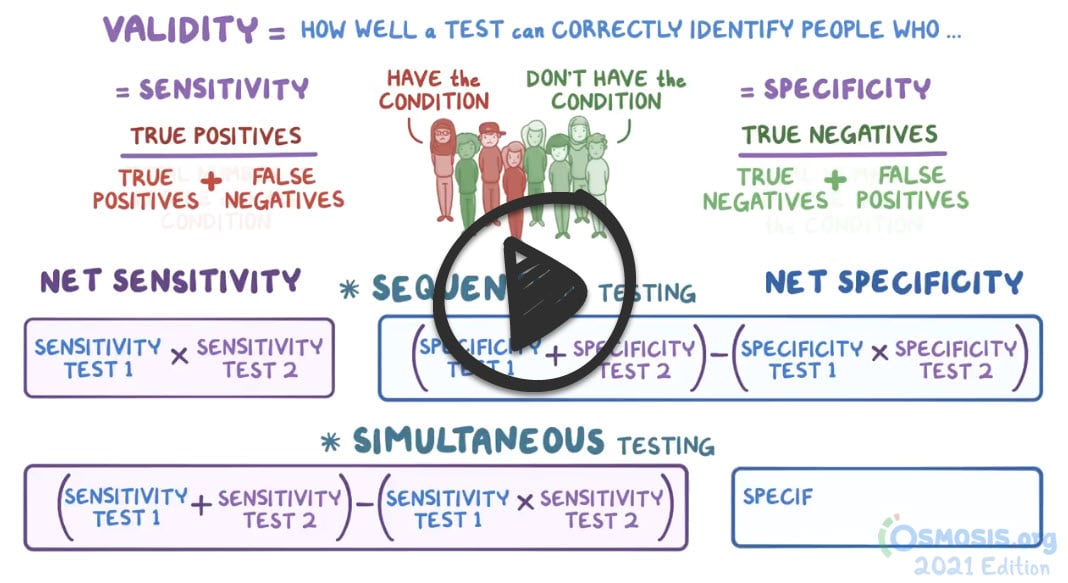 |

Sensitivity and specificity are statistical measures that indicate how well a test can measure the presence of a specific disease. Ideally, a perfect test or predictor would be 100% sensitive and 100% specific, meaning that the test would predict all people from the sick group as sick and exclude anyone from the healthy group as sick. However, for any test, there is usually a trade-off between these measures. Sensitivity relates to the test’s ability to identify positive results. It is the proportion of people that are known to have the disease that test positive for it. The formula for identifying sensitivity equals the number of true positives divided by the (number of true positive + number of false negatives). A test with high sensitivity is often a reliable indicator of ruling out a disease because a negative result can reliably be assumed to be true. An easy way to remember this is remembering the word “SN OUT” meaning sensitivity is used to “rule OUT” disease. Because a test with high sensitivity rarely misses true positives among those who are actually positive, it is often used as a screening test to ensure that all people with disease are identified. However, tests with high sensitivity can create false positives, meaning patients that do not have disease may have a positive test result.
Play Video + QuizSpecificity

Specificity relates to the test’s ability to identify negative results. It is the proportion of patients that are known not to have the disease who will test negative for it. The formula for identifying specificity equals the number of true negatives divided by the (number of true negatives + number of false positives). Highly specific tests rarely miss negative outcomes so they can be considered reliable when their test result is positive. Therefore, a positve result from a test with high specificity means a high probability of the presence of disease. Tests with high specificity are often used to “rule in” disease and can be remembered by the word SPIN for specificity “rules in”. Because there are few false positives in diseases with high specificity, they are often used as confirmatory tests for the presence of disease.
Play Video + Quiz