

Bullous pemphigoid: The Daily PANCE Blueprint
A 72F develops several weeks of intense pruritus followed by large, tense blisters on an erythematous base on her trunk and flexor forearms. Nikolsky sign is negative. A biopsy is sent for direct immunofluorescence. Which finding is most characteristic?
A. Intercellular IgG in a “fish-net” pattern
B. Granular IgA deposition in dermal papillae
C. Linear deposition of IgG and C3 along the dermal-epidermal junction
D. Linear IgA deposition along the basement membrane only
E. Predominant epidermal neutrophilic microabscesses
The answer is C. Linear deposition of IgG and C3 along the dermal-epidermal junction
Bullous pemphigoid is an autoimmune blistering disorder caused by IgG autoantibodies against hemidesmosomal proteins (BP180/BP230) at the basement membrane. This creates a subepidermal split, producing tense bullae that are less likely to rupture than pemphigus vulgaris. Direct immunofluorescence shows linear IgG and C3 deposited along the dermal-epidermal junction (basement membrane zone). Clinically, pruritus often precedes blistering, and mucosal involvement is uncommon.
Board Pearl: Tense bullae + negative Nikolsky + linear IgG/C3 at the dermal-epidermal junction = bullous pemphigoid (subepidermal blister).
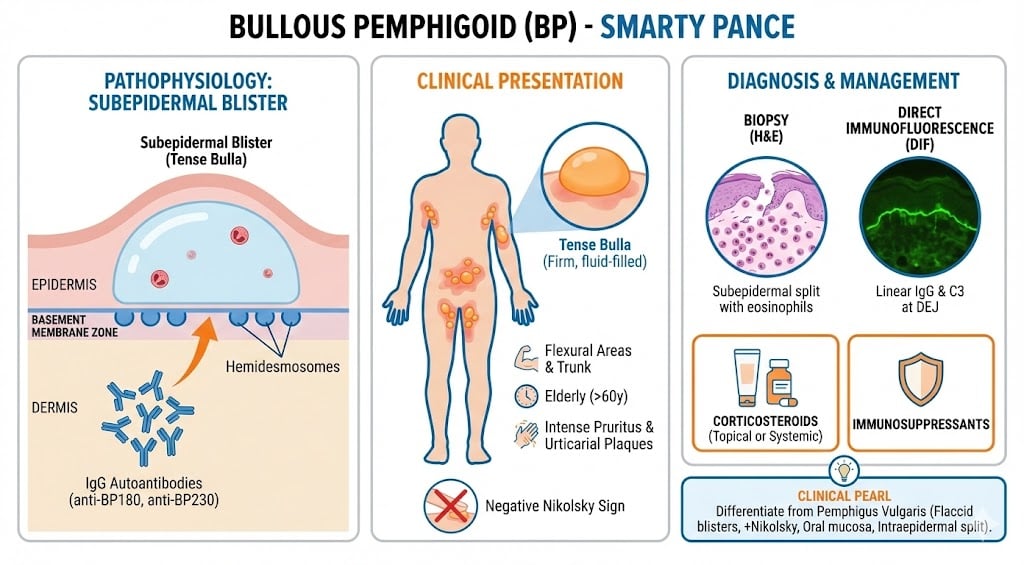
Smarty PANCE Content Blueprint Review:
Covered under ⇒ PANCE Blueprint Dermatology ⇒ Vesiculobullous disease ⇒ Bullous pemphigoid
Also covered as part of the Emergency Medicine EOR and Family Medicine EOR topic lists