

 Lecture
 Picmonic
Patient will present as → a 33-year-old female who reports that her coworkers are planning to have her fired and often ridicule her when she is not there. She is pursuing legal action to have her coworkers reprimanded for this behavior, as she knows they intend to harm her in some way.

To watch this and all of Joe Gilboy PA-C's video lessons you must be a member. Members can log in here or join now.
Key Points:
- Paranoid personality disorder is characterized by persistent feelings of suspiciousness and mistrust of other people.
- Differentiated from delusional disorder or schizophrenia by the absence of fixed delusions or hallucinations
DSM-5 Diagnostic Criteria
A. A pervasive distrust and suspiciousness of others such that their motives are interpreted as malevolent, beginning by early adulthood and present in a variety of contexts, as indicated by four (or more) of the following:
- Suspects, without sufficient basis, that others are exploiting, harming, or deceiving him or her.
- Is preoccupied with unjustified doubts about the loyalty or trustworthiness of friends or associates.
- Is reluctant to confide in others because of unwarranted fear that the information will be used maliciously against him or her.
- Reads hidden demeaning or threatening meanings into benign remarks or events.
- Persistently bears grudges (i.e., is unforgiving of insults, injuries, or slights).
- Perceives attacks on his or her character or reputation that are not apparent to others and is quick to react angrily or to counterattack.
- Has recurrent suspicions, without justification, regarding fidelity of spouse or sexual partner.
B. Does not occur exclusively during the course of schizophrenia, a bipolar disorder or depressive disorder with psychotic features, or another psychotic disorder and is not attributable to the physiological effects of another medical condition.
Psychotherapy, especially cognitive behavioral therapy (CBT), is the mainstay of treatment, aimed at improving trust, coping mechanisms, and interpersonal skills
- Medications (e.g., antipsychotics or anxiolytics) may be used short-term for severe anxiety or transient psychotic symptoms, but pharmacotherapy is not primary treatment
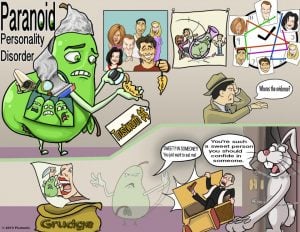
Paranoid personality disorder is characterized by persistent feelings of suspiciousness and mistrust of other people. Patients with paranoid personality disorder are preoccupied with analyzing social interactions and are constantly suspicious of trusting others without underlying reasons. They are reluctant to confide in others and tend to hold grudges. They misinterpret others’ remarks and perceive them as personal insults.
Play Video + QuizQuestion 1 |
Bipolar I disorder Hint: While a serious mental illness with genetic links, the primary familial association for PPD and other Cluster A disorders is with the schizophrenia spectrum, not mood disorders like bipolar disorder. | |
Schizophrenia | |
Antisocial personality disorder Hint: Antisocial personality disorder is a Cluster B disorder. Its familial and genetic links are stronger with other Cluster B disorders and externalizing disorders like substance use, not with the odd/eccentric traits of Cluster A. | |
Major depressive disorder Hint: Depression is a common condition with some heritability, but it is not specifically linked to the development of paranoid personality traits in the same way as psychotic disorders. | |
Obsessive-compulsive disorder Hint: OCD is now classified in its own category in the DSM-5. While it has genetic components, it is not specifically linked to the development of PPD. |
Question 2 |
She avoids social interaction due to fear of criticism Hint: Suggests avoidant personality disorder, not PPD | |
She has delusions of persecution and auditory hallucinations Hint: Hallmark of schizophrenia or psychotic disorders, not personality disorders | |
Her behavior is driven by impulsivity and fear of abandonment Hint: Characteristic of borderline personality disorder | |
Lack of interest in relationships or emotions Hint: Describes schizoid personality disorder | |
Her symptoms began in early adulthood and are pervasive |
Question 3 |
Challenging the patient's paranoid interpretations of his wife's actions Hint: Direct confrontation or challenging of paranoid thoughts is contraindicated in the initial stages of therapy. This will almost certainly be interpreted as the therapist "siding" with others against him, confirming his suspicions and leading him to terminate treatment. | |
Encouraging him to join a group therapy session to improve his social skills Hint: Group therapy is generally not well-tolerated by individuals with PPD, especially early in treatment. Their pervasive distrust of others' motives makes it extremely difficult for them to engage in a group setting, which they may perceive as threatening or conspiratorial. | |
Prescribing a low-dose antipsychotic medication to reduce his suspiciousness Hint: The primary treatment is psychotherapy. Introducing medication early on, especially to a patient who is already suspicious of your motives, is likely to be met with extreme resistance and non-adherence. | |
Establishing a therapeutic alliance through a professional, reliable, and straightforward approach | |
Exploring the unconscious childhood conflicts that led to his mistrust Hint: While insight-oriented or psychodynamic approaches may eventually have a role in helping the patient understand the origins of his mistrust, this is not an appropriate initial goal. Attempting to delve into sensitive past experiences before a strong therapeutic alliance has been formed will be perceived as intrusive and threatening. |
|
List |