

 Lecture
Patient will present as → a 21-year-old female complaining of poor school performance. She is concerned about her performance despite reassurance from her professors. She tells you that her symptoms occur daily, consisting of sleep disturbances, difficulty concentrating, and irritability. She reports her symptoms started around age 16 but have worsened.

To watch this and all of Joe Gilboy PA-C's video lessons you must be a member. Members can log in here or join now.
Key Points:
- Generalized anxiety disorder (GAD) involves persistent and excessive worry pertaining to multiple events or domains that continues for > 6 months
- Anxiety is not related to a specific focus, but rather is generalized to most issues
- GAD is the most common psychiatric illness seen by primary care providers.
DSM-5 Diagnostic Criteria
- Excessive anxiety and worry (apprehensive expectation), occurring more days than not for at least 6 months, about a number of events or activities (such as work or school performance).
- The individual finds it difficult to control the worry.
- The anxiety and worry are associated with three (or more) of the following six symptoms (with at least some symptoms having been present for more days than not for the past 6 months): Note: Only one item is required in children.
- Restlessness or feeling keyed up or on edge.
- Being easily fatigued.
- Difficulty concentrating or mind going blank.
- Irritability.
- Muscle tension
- Sleep disturbance (difficulty falling or staying asleep, or restless, unsatisfying sleep).
- The anxiety, worry, or physical symptoms cause clinically significant distress or impairment in social, occupational, or other important areas of
- The disturbance is not attributable to the physiological effects of a substance (e.g., a drug of abuse, a medication) or another medical condition (e.g., hyperthyroidism).
- The disturbance is not better explained by another mental disorder (e.g., anxiety or worry about having panic attacks in panic disorder, negative evaluation in social anxiety disorder [social phobia], contamination or other obsessions in obsessive-compulsive disorder, separation from attachment figures in separation anxiety disorder, reminders of traumatic events in posttraumatic stress disorder, gaining weight in anorexia nervosa, physical complaints in somatic symptom disorder, perceived appearance flaws in body dysmorphic disorder, having a serious illness in illness anxiety disorder, or the content of delusional beliefs in schizophrenia or delusional disorder).
To be considered generalized anxiety disorder, symptoms must occur for more than 6 months
- Patients with GAD might show psychological signs, physical signs, or somatic signs. At times, they might show similar symptoms of a myocardial infarction. A quick ECG, along with Troponin levels and CK-MB, should rule out an MI
- Rule out medical disorders such as substance abuse, thyroid dysfunction, or ETOH withdrawal
Psychotherapy, usually cognitive-behavioral therapy, can be both supportive and problem-focused. Relaxation and biofeedback may be of some help, although few studies have documented their efficacy.
Pharmacologic
- SSRIs: Paroxetine and escitalopram
- Take several weeks to work
- Buspirone is also effective; the starting dose is 5 mg PO bid or tid. However, buspirone can take at least 2 wk before it begins to help.
- Can be used as an adjunct to SSRIs
- SNRIs: Venlafaxine extended-release, starting dose 37.5 mg PO once/day
- Benzodiazepines
- Used in the interim until the SSRI response is seen
- Not used for long-term management as a result of abuse potential
- Herbal
- The kava plant has been shown in verified studies to have a mild beneficial effect for patients with generalized anxiety disorder
- Kava toxicity manifests as liver failure, hepatitis, or cirrhosis
- The kava plant has been shown in verified studies to have a mild beneficial effect for patients with generalized anxiety disorder
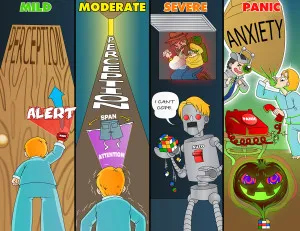
Anxiety is one of the few psychological responses to stress. Each patient may exhibit different feelings or behaviors in response to stress. However, the primary characteristics are feelings of apprehension and uncertainty. Typically, patients can manage anxiety and move on, but in some cases, anxiety can become problematic when it starts interfering with the ability to meet basic needs. Knowing the different levels of anxiety is important when planning interventions to treat anxiety.
Play Video + QuizBuspirone

Buspirone is a medication used to treat generalized anxiety disorder. Its behavioral effects are attributable to its actions on the 5-HT1A receptor as a partial agonist, as well as causing the release of dopamine and NE. This drug has a low side effect profile and does not interact with alcohol.
Question 1 |
10% | |
30% | |
50% | |
80% |
Question 2 |
awakening with apprehension and unrealistic concern about future misfortune | |
worry out of proportion to the likelihood or impact of feared events | |
a 6-month or longer course of anxiety and associated symptoms | |
association of the anxiety with depression | |
anxiety exclusively focused on health concerns |
Question 3 |
cognitive-behavioral therapy (CBT) | |
hypnosis | |
supportive psychotherapy | |
psychoanalytic psychotherapy | |
none of the above |
Question 4 |
venlafaxine Hint: Venlafaxine and duloxetine, mixed serotonin-norepinephrine reuptake inhibitors, can be used for short- and long-term treatment | |
buspirone Hint: Buspirone, a nonbenzodiazepine anxiolytic, and other agents such as tricyclic antidepressants are used as well | |
benzodiazepines Hint: Although benzodiazepines are commonly used, they have mostly short-term benefits. Longer acting agents are preferred to short-acting benzodiazepines, but their use should be limited, if possible, because of withdrawal symptoms, habituation, and impaired mental and physical performance | |
selective serotonin reuptake inhibitors (SSRIs) Hint: SSRIs are often used in the pharmacologic treatment of GAD | |
clozapine |
Question 5 |
elderly white men | |
school-age children | |
married people | |
those of higher socioeconomic status | |
young to middle-aged women |
|
List |