

 Lecture

Patient will present as → a 32-year-old female presents with fever, chills, nausea, and flank pain for 24 hours. She developed dysuria and urinary frequency 3 days prior and states that both have worsened. On physical exam, you note suprapubic abdominal pain and CVA tenderness. The urinalysis reveals white blood cell casts.

To watch this and all of Joe Gilboy PA-C's video lessons, you must be a member. Members can log in here or join now.
Presents with fever, chills, nausea, and flank pain
- (+) CVA Tenderness (also a symptom of renal calculi)
- If symptoms are severe or the patient is unable to tolerate PO, they will need to be hospitalized
- Escherichia coli (E. coli) is by far the most common causative agent, responsible for approximately 70-80% of acute pyelonephritis cases
White blood cell casts in urine are pathognomonic for pyelonephritis
- If complicated pyelonephritis - order a renal ultrasound as it may show hydronephrosis secondary to obstruction

White blood cell (WBC) cast in urine. Image: Ajay Kumar Chaurasiya, CC BY-SA 4.0, via Wikimedia Commons.
7 days of outpatient treatment is equivalent to longer treatment regimens
- IV antibiotics are indicated for inpatients who are toxic or unable to tolerate oral antibiotics
An oral regimen is considered the best initial outpatient treatment
- Ciprofloxacin: 500 mg BID for 7 days
- Ciprofloxacin XR: 1,000 mg/day for 7 days
- Levofloxacin: 750 mg/day for 5 days
- Trimethoprim/sulfamethoxazole (TMP-SMX) (160/800 mg): 1 tab PO BID for 7 days provided uropathogen known to be susceptible and ceftriaxone 1 g initial IV dose given
- Oral beta-lactam (cefpodoxime, cefuroxime, amoxicillin-clavulanate, cefadroxil) for 7 days if susceptible, after an initial IV ceftriaxone dose (IDSA 2025)
Management of acute pyelonephritis in pregnant women includes hospital admission for parenteral antibiotics
- Empiric therapy includes IV/IM ceftriaxone
 Osmosis |
|
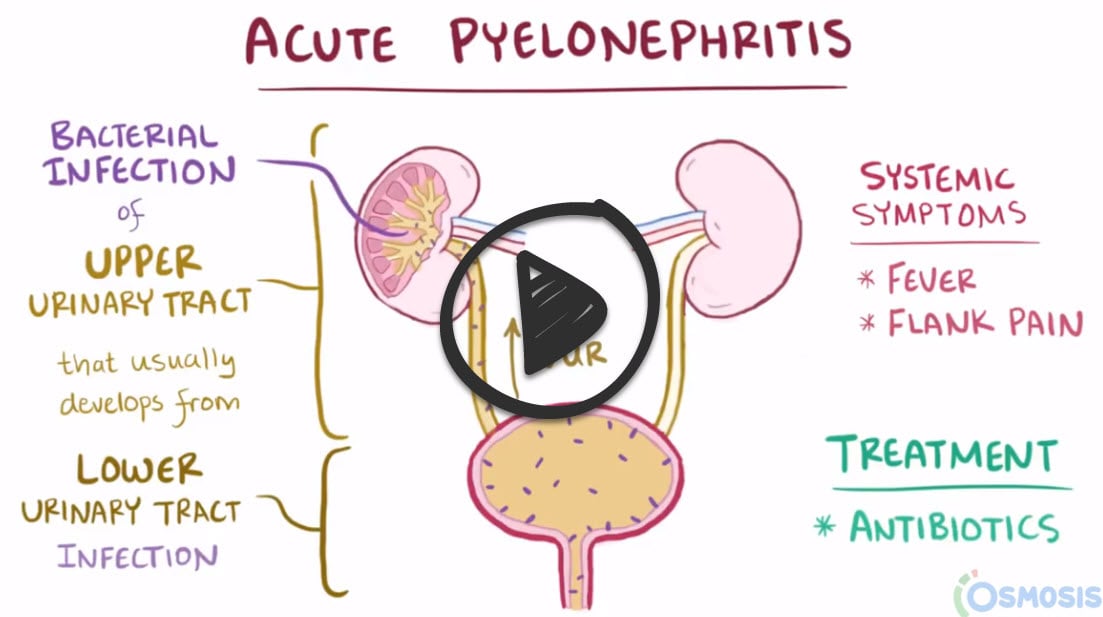 |

Pyelonephritis is inflammation in an area of the kidney called the renal parenchyma. This condition is caused by a bacterial infection that begins in the lower urinary tract and travels upward and into the kidney(s). Patients with vesicoureteral reflux, urinary obstruction, or patients who are pregnant are at an increased risk of developing pyelonephritis. Presenting symptoms include fatigue, fever, chills, flank pain, nausea, vomiting, dysuria, and possible hematuria.
| Pyelonephritis assessment | Play Video + Quiz |
| Pyelonephritis interventions | Play Video + Quiz |
Question 1 |
Ciprofloxacin | |
Erythromycin Hint: Erythromycin does not reliably cover the gram-negative organisms (E. coli) that cause pyelonephritis. | |
Doxycycline Hint: Doxycycline treats chlamydia and some STIs; it does not reach adequate kidney levels for pyelonephritis. | |
Amoxicillin Hint: Amoxicillin is not used empirically because E. coli resistance to it is high. |
Question 2 |
acute salpingitis Hint: Acute salpingitis would be suggested if pelvic exam abnormalities were present. | |
nephrolithiasis Hint: Nephrolithiasis does not usually present with fever or casts. Urinalysis will have RBCs present. | |
acute pyelonephritis | |
appendicitis Hint: This scenario is consistent with acute pyelonephritis, not acute appendicitis. |
Question 3 |
Hyaline casts Hint: Hyaline casts may be found in concentrated urine and are not indicative of renal disease. | |
Red cell casts Hint: Red cell casts are indicative of glomerulonephritis. | |
White cell casts | |
Granular casts Hint: Granular casts are non-specific and may be seen in acute tubular necrosis |
Question 4 |
Oral ciprofloxacin (Cipro) Hint: Fluoroquinolones are avoided in pregnancy, and pyelonephritis in pregnancy is treated with IV therapy in the hospital at first. | |
Oral trimethoprim-sulfamethoxazole (Bactrim) Hint: Pyelonephritis in pregnancy needs initial IV therapy; TMP-SMX is also avoided in the first trimester and near term. | |
IV gentamicin (Garamycin) Hint: Gentamicin is not indicated as first line therapy in the treatment of pyelonephritis in a pregnant patient | |
IV ceftriaxone (Rocephin) |
|
List |
References: Merck Manual · UpToDate