


Patient will present as → a 60-year-old woman with a severe drug-induced reaction on both lower limbs with few lesions elsewhere in addition to mucosal involvement of the mouth of two days duration. The insulting drug was a sulfonamide, started two weeks before the rash appeared. The rash comprises bilateral symmetrical bullae on a background of erythematous macules and patches in addition to erosions and peeling.
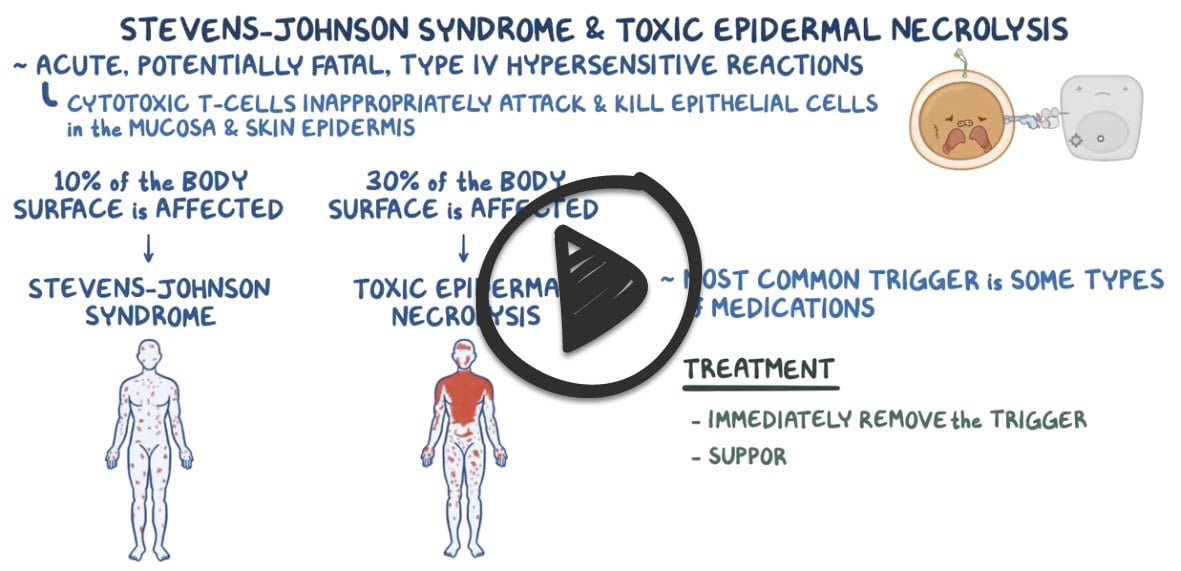
Stevens-Johnson syndrome (SJS) is the milder end of the same disease spectrum as toxic epidermal necrolysis (TEN), with LESS THAN 10% of body surface area detachment
- Stevens-Johnson syndrome, SJS/TEN overlap, and toxic epidermal necrolysis are one spectrum of severe cutaneous adverse reactions (SCAR) affecting the skin and mucous membranes
The distinction between SJS, SJS/TEN overlap, and TEN is based solely on the percentage of body surface area with blisters and erosions
- SJS: < 10% of the body surface
- SJS/TEN overlap: 10–30%
- TEN: > 30%
Remember: SJS is a drug reaction on the same spectrum as toxic epidermal necrolysis (TEN) with LESS THAN 10% of body surface area detachment, layers of skin peel away in sheets (+) Nikolsky’s sign, and it is most commonly caused by allopurinol, anticonvulsants, and sulfa drugs!
- Severe, potentially fatal, mucocutaneous drug reactions characterized by epidermal necrosis involving the skin and usually ≥ 2 mucous membranes
- Most common with drug eruptions: over 100 medications have been implicated, especially allopurinol, anticonvulsants (carbamazepine, lamotrigine, phenytoin), sulfa drugs, and NSAIDs — typically 1–3 weeks after starting the drug (within 48 hours on re-exposure)
- Prodromal period for 1–7 days of low-grade fever, sore throat or upper respiratory infection or dysphagia, and general malaise; the patient may also complain of pain or stinging in the eyes
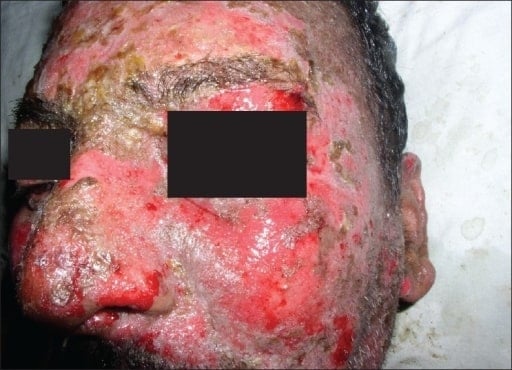
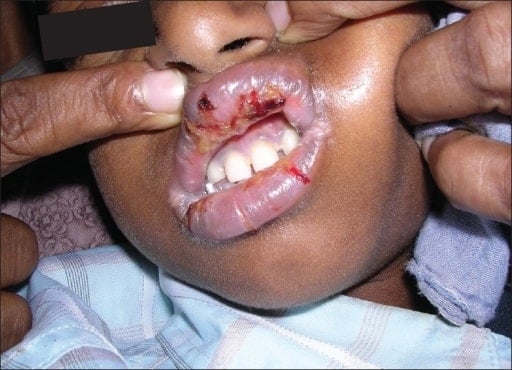
- Subsequent development of targetoid red papules and plaques with dusky, blistered, or eroded centers as well as mucosal (lip, intraoral, conjunctival, urethral, anal) pain with blistering and erosions
- Progression to sheets of widespread epidermal necrosis and sloughing may occur over hours. This is a medical emergency.
- Eye symptoms may be severe
- (+) Nikolsky's sign: skin peels away in sheets when pressure is applied and rubbed
Clinical evaluation and skin biopsy — shows full-thickness epidermal necrosis
- If the test is available, elevated levels of serum granulysin taken in the first few days of a drug eruption may be predictive of SJS/TEN.
- Diagnosis is often obvious from the appearance of lesions and rapid progression of symptoms. Histologic examination of sloughed skin shows full-thickness necrotic epithelium, a distinguishing feature.
- Differential diagnosis in SJS and early TEN includes erythema multiforme, viral exanthems, and other drug rashes; SJS/TEN can usually be differentiated clinically as the disorder evolves and is characterized by significant pain and skin sloughing.
Mortality prediction scoring: SCORTEN Scale SCORTEN is an illness severity score that has been developed to predict mortality in SJS and TEN cases. One point is scored for each of the seven criteria present at the time of admission. The SCORTEN criteria are:
|
The risk of dying from SJS/TEN depends on the score.
|
ABCD-10 Mortality prediction model score A: Age over 50 years (one point) B: Bicarbonate level < 20 mmol/L (one point) C: Cancer present and active (two points) D: Dialysis prior to admission (3 points) 10: Epidermal detachment ≥ 10% of body surface area on admission (one point)
| ABCD-10 Score | Predicted Mortality Rate, % (95% CI) |
|---|---|
| 0 | 2.3 (1.1-4.6) |
| 1 | 5.4 (3.2-8.7) |
| 2 | 12.3 (8.9-16.6) |
| 3 | 25.5 (19.6-32.5) |
| 4 | 45.7 (34.2-57.8) |
| 5 | 67.4 (50.8-80.6) |
| 6 | 83.6 (66.7-92.8) |
Stop all potentially offending medications — the single most important intervention
- Early admission to a burn unit or pediatric intensive care unit for initial stabilization and management of fluids, electrolytes, and nutrition; airway stability; and wound care
- Prompt ophthalmology and dermatology consultation — corneal scarring and blindness are the feared sequelae
- Adjuncts: cyclosporine is increasingly favored; intravenous immunoglobulin (IVIG) has mixed evidence; systemic steroids remain controversial (increased risk of sepsis)
- Prevention pearl: screen HLA-B*15:02 before carbamazepine in patients of Asian ancestry (and HLA-B*58:01 before allopurinol)
Flashcards ready when you areYou have opened several Quizlet sets recently. Loading this one only when needed helps prevent a temporary Quizlet limit.
 Osmosis Osmosis |
|
 |
Picmonic
 Stevens-Johnson syndrome is a blistering skin disorder most often caused by drug reactions. It initially begins as a fever, but later involves the mucosa and skin, leading to blistering, necrolysis and skin sloughing. An important distinction to realize is that Stevens-Johnson syndrome (SJS) involves less than 10% of the body surface area, SJS/TEN overlap involves 10–30%, and involvement of more than 30% of the body surface area is classified as Toxic Epidermal Necrolysis (TEN). This syndrome has a high mortality rate, and treatment centers on stopping the offending drug and intensive supportive care.
| Stevens-Johnson syndrome | Play Video + Quiz |
| Lamotrigine | Play Video + Quiz |
| Ethosuximide | Play Video + Quiz |
| Carbamazepine (Tegretol) | Play Video + Quiz |
| Sulfa drug allergies | Play Video + Quiz |
Question 1 |
A 48-year-old male presents with widespread erosions and detachment of the epidermis suspected to be Stevens-Johnson syndrome. He recently started several new medications. Which of the following medications is NOT a commonly reported trigger for Stevens-Johnson syndrome?
Phenytoin Hint: Antiepileptic and known SJS trigger | |
Allopurinol Hint: Frequent trigger for SJS | |
Sulfamethoxazole Hint: Sulfonamide antibiotic known for causing SJS | |
Ibuprofen | |
Carbamazepine Hint: Antiepileptic with SJS risk |
Question 1 Explanation:
Stevens-Johnson syndrome is commonly triggered by medications like antiepileptics, sulfonamide antibiotics, and allopurinol. NSAIDs like ibuprofen are NOT commonly implicated triggers for SJS.
Question 2 |
Which of the following is incorrect about Stevens-Johnson syndrome (SJS)?
It is a milder form of toxic epidermal necrolysis with less than 20% body surface area detachment | |
Nevirapine is a trigger | |
Loss of vision could be a complication | |
Corticosteroid may be used in the treatment of patients with SJS |
Question 2 Explanation:
SJS is a milder form of toxic epidermal necrolysis with less than 10% body surface area detachment. All other statements are correct.
Question 3 |
A 40-year-old female with Stevens-Johnson syndrome is admitted to the hospital. She has extensive blistering and epidermal detachment covering 5% of her body surface area. Which of the following is the most appropriate initial step in the management of this patient?
High-dose systemic corticosteroids Hint: Their use in SJS is controversial and not universally recommended as an initial step. | |
Intravenous immunoglobulin (IVIG) Hint: May be used in treatment, but the priority is to stop the offending agent. | |
Immediate discontinuation of all non-essential medications | |
Start of broad-spectrum antibiotics Hint: Antibiotics are not routinely started unless there is evidence of secondary infection. | |
Cyclosporine therapy Hint: Used in some cases, but not before discontinuing the causative medication. |
Question 3 Explanation:
The first and most crucial step in managing Stevens-Johnson syndrome is the immediate discontinuation of all non-essential medications, especially any recently started drugs that could be the potential cause. This helps prevent further progression of the disease.
There are 3 questions to complete.
|
List |
References: Merck Manual · UpToDate