

EKG Rhythm Strips with Joe Gilboy PA-C

To watch this and all of Joe-Gilboy PA-C's high-yield video lessons you must be a member. Members can log in here or join now.
In the flashcard set choose "options" and then "answer with English" before starting.
Flashcards ready when you areYou have opened several Quizlet sets recently. Loading this one only when needed helps prevent a temporary Quizlet limit.
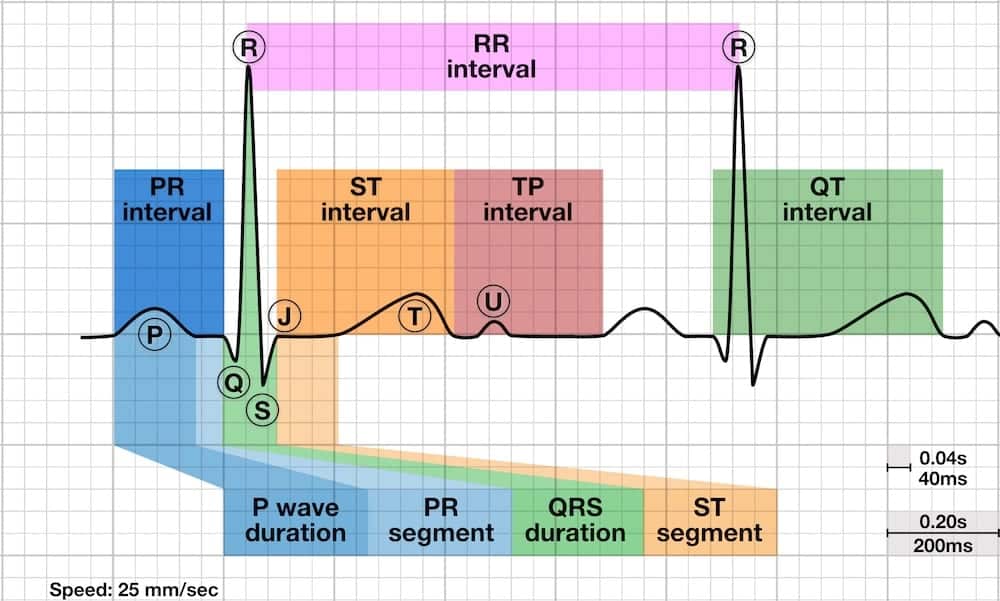
| PROTOTYPICAL ECG TRACING | |
| P-wave | Electrical activity is traveling through the atria. Synonymous with atrial depolarization. Reflects atrial contraction. |
| QRS Complex |
Electrical activity is traveling through the ventricles. Depolarization of the left and right ventricles. Reflects ventricular contraction. |
| T-wave | Synonymous with ventricular repolarization. Reflects the start of ventricular relaxation. |
| PR Interval | Onset of the P-wave to the start of the QRS complex. Reflects conduction through the atrioventricular (AV) node. |
| PR Segment | End of the P-wave to the start of the QRS complex. Reflects time delay between atrial and ventricular activation. |
| ST Interval | Onset of the S-wave to the start of the T-wave. Reflects initial, slow phase of ventricular repolarization. |
| ST Segment | End of the S-wave (J point) to the start of the T-wave. Reflects ventricular repolarization. |
| QT Interval | Onset of the QRS complex to the end of the T-wave. Reflects the period between ventricular depolarization and ventricular repolarization. |
| TP Interval | End of the T-wave to the end of the P-wave. Reflects a period of electrical inactivity. |
| RR Interval | Reflects time elapsed between tw |