

Patient will present as → a 3-year-old male who is brought to your office by his mother, who is concerned that he is not growing appropriately. Physical examination is notable for frontal bossing and shortened upper and lower extremities. His axial skeleton appears normal. He is at the fourth percentile for height and the 95th percentile for head circumference. He demonstrates normal intelligence and can speak in three-word sentences. He first sat up without support at 12 months and started walking at 24 months. Labs reveal decreased GH and decreased IGF-1.
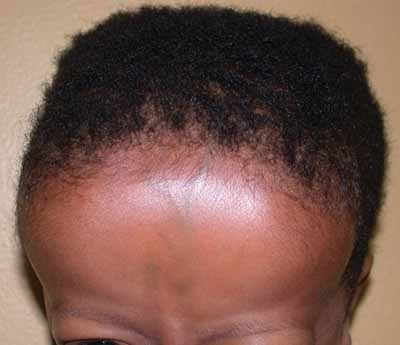
Pituitary dwarfism, or growth hormone deficiency, is a condition in which the pituitary gland does not make enough growth hormone. This results in a child's slow growth pattern and unusually small stature (below average height)
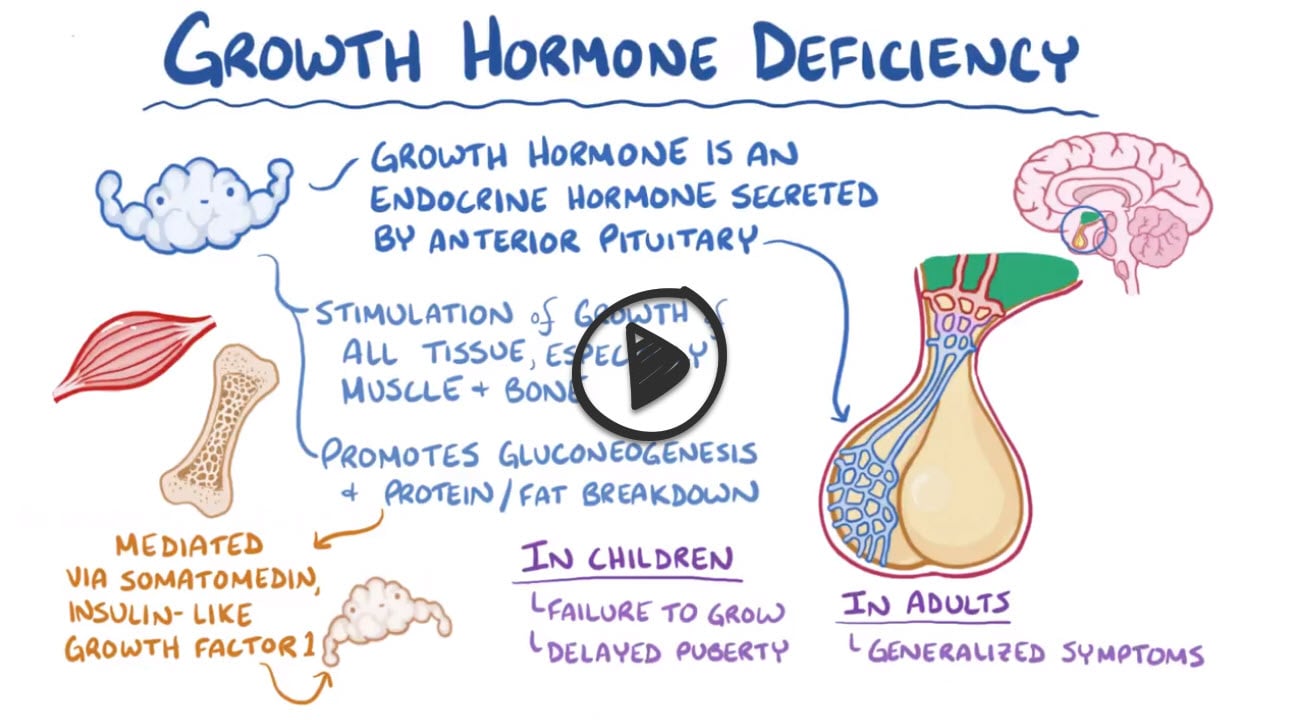
- Growth hormone secretion can be decreased in adults, resulting in lower bone density and decreased muscle mass, but this will not affect bone growth
- The primary manifestations of growth hormone deficiency in infancy are hypoglycemia and micropenis
- In children, bone growth is typically delayed relative to chronological age due to an under-stimulation of osteoblasts which can result in short stature
Growth hormone (GH) deficiency can occur in isolation or in association with generalized hypopituitarism
- Causes include congenital (including genetic) disorders and several acquired disorders of the hypothalamus and/or pituitary
Differential Diagnosis of Short Stature
| Growth Hormone Deficiency (GHD) | Constitutional Growth Delay | Familial Short Stature | |
| Growth velocity | ↓ (slow, <5 cm/year) | Normal after early slowing | Normal |
| Bone age | ≥2 years behind chronological age | Delayed but eventually catches up | Matches chronological age |
| Puberty | May be delayed, remains short without treatment | Delayed, but normal adult height | Normal timing, short adult height |
| Labs | ↓ IGF-1, abnormal GH stimulation test | Normal IGF-1, normal stimulation test | Normal |
| Final adult height | Short without GH therapy | Normal (late growth spurt) | Short, similar to parents |
Serial measurements >2.5 deviations below the normal mean should prompt growth hormone evaluation
- Labs: ↓ GH, ↓ IGF-1, ↓ IGFBP-3
- Low IGF-1/IGFBP-3 suggests GHD but may also be low in malnutrition, chronic illness, or hypothyroidism → not diagnostic alone
BONE AGE:
- X-ray the child’s hand/wrist to compare bone age with chronological age
- In GHD, bone age is usually ≥2 years behind chronological age (This means that if a child is ten years old, his or her bones will look like they are those of an eight-year-old child)
- Helps differentiate from:
- Familial short stature → bone age = chronological age
- Constitutional growth delay → bone age delayed, but GH testing normal
Growth Hormone Stimulation Test (confirmatory):
- Random GH levels are unreliable (secreted in pulses)
- Pharmacologic stimuli used: insulin, arginine, clonidine, or glucagon
- Normal response: GH rises >10 ng/mL
- GHD: GH fails to rise appropriately → confirms diagnosis
Imaging:
- MRI of the brain/pituitary to evaluate for cause (eg, craniopharyngioma, pituitary tumor, prior surgery or radiation)
- Children with suspected GHD often have low or normal random GH levels, because GH is secreted pulsatile (in bursts during the day, especially at night). This makes a single GH level unreliable.
- Instead, stimulation testing is performed: the child is given a pharmacologic stimulus (such as insulin-induced hypoglycemia, arginine, clonidine, or glucagon) to trigger GH release.
- In normal children, these stimuli cause a marked rise in GH levels above a diagnostic threshold (usually >10 ng/mL).
- In GHD, the pituitary cannot mount this response, and GH levels remain subnormal.
- This test helps differentiate true GHD from other causes of short stature (eg, constitutional growth delay, familial short stature).
Growth hormone deficiency can be treated with subcutaneous injections of recombinant human growth hormone to try and stimulate normal growth
- Surgery may be necessary to remove a pituitary adenoma if that is the cause of dwarfism
- Other manifestations of hypopituitarism are treated as needed
- Complications: Poorly developed organs including the heart, impaired sexual maturation, kyphosis, arthritis, sleep apnea, spinal stenosis, motor delays, ear infections, hearing loss
 Osmosis Osmosis |
|
 |
Question 1 |
Familial short stature | |
Constitutional delay of growth and puberty Hint: Constitutional delay also shows growth parallel to the curve, but the bone age is delayed relative to chronologic age and there is usually a family history of late bloomers. Here bone age equals chronologic age and the parents are simply short. | |
Growth hormone deficiency Hint: Growth hormone deficiency causes a falling growth velocity with the child crossing percentiles downward, often with a delayed bone age. A steady, normal growth velocity argues against it. | |
Hypothyroidism Hint: Hypothyroidism slows growth velocity and delays bone age, and it usually brings fatigue, constipation, and cold intolerance. Normal thyroid function tests exclude it here. | |
Noonan syndrome Hint: Noonan syndrome causes short stature in boys and girls, but it comes with a characteristic appearance (widely spaced eyes, low-set ears, webbed neck), a pulmonary valve stenosis or hypertrophic cardiomyopathy, and often a delayed bone age. A normal examination and a bone age that matches chronologic age argue against it. |
Question 2 |
Bone age is advanced in both familial short stature and constitutional delay of growth Hint: This statement is incorrect as bone age is typically normal in familial short stature and delayed in constitutional delay of growth. | |
Bone age is delayed in familial short stature and normal in constitutional delay of growth Hint: This is the opposite of the actual relationship; bone age is normal in familial short stature and delayed in constitutional delay of growth. | |
Bone age is normal in familial short stature and delayed in constitutional delay of growth | |
Bone age is delayed in both constitutional delay of growth and growth hormone deficiency Hint: While bone age is delayed in constitutional delay of growth, it is also typically delayed in growth hormone deficiency, not normal. | |
Bone age is advanced in constitutional delay of growth and delayed in hypothyroidism Hint: Bone age is actually delayed in constitutional delay of growth. In hypothyroidism, bone age is also typically delayed, not advanced. |
Question 3 |
Oral growth hormone supplementation Hint: Growth hormone is not effective orally as it is digested in the stomach and thus inactivated before it can be absorbed. | |
Subcutaneous recombinant growth hormone injections | |
High-dose corticosteroids Hint: Corticosteroids can actually inhibit growth and are not used in the treatment of growth hormone deficiency. | |
Thyroxine supplementation Hint: While thyroid hormone is important for growth and development, thyroxine supplementation alone is not a treatment for growth hormone deficiency unless the patient also has hypothyroidism. | |
Insulin-like growth factor-1 (IGF-1) therapy Hint: IGF-1 is a downstream effect of growth hormone action. Although it plays a role in growth, the primary treatment for GH deficiency is recombinant growth hormone, not IGF-1 therapy. |
|
List |
References: Merck Manual · UpToDate