Urethral disorders (PEARLS)
The NCCPA™ PANCE Genitourinary Content Blueprint urethral disorders
Q
Flashcards ready when you areYou have opened several Quizlet sets recently. Loading this one only when needed helps prevent a temporary Quizlet limit.
| Urethral Prolapse |
Patient will present as → a mother of a 3-year-old girl who is concerned because she saw blood in her daughter’s underpants. The patient complains of no pain. Examination demonstrates a complete circular eversion of the distal urethral mucosa. Circumferential protrusion of the distal urethra through the external urethral meatus. It is a rarely diagnosed condition that occurs most commonly in prepubertal girls and postmenopausal women
- Vaginal bleeding is the most common presenting symptom of urethral prolapse
- Upon examination, round, often doughnut-shaped protrusion mucosa is observed obscuring the urethral opening
DX: Diagnosis is clinical and urethral prolapse is often an incidental finding during a routine examination
- Routine evaluation with urograms and voiding cystourethrography is unnecessary except in patients who may have evidence of malignancy
TX: Treatment includes topical estrogen creams, Vaseline, and sitz baths
- Surgical excision is justified in young patients with symptomatic urethral prolapse or with recurrent urethral prolapse
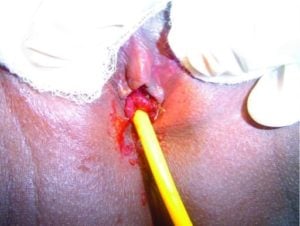 Image: Urethral Prolapse Ligated Over a Foley Catheter by Okorie CO CC BY 3.0 |
| Urethral Stricture |
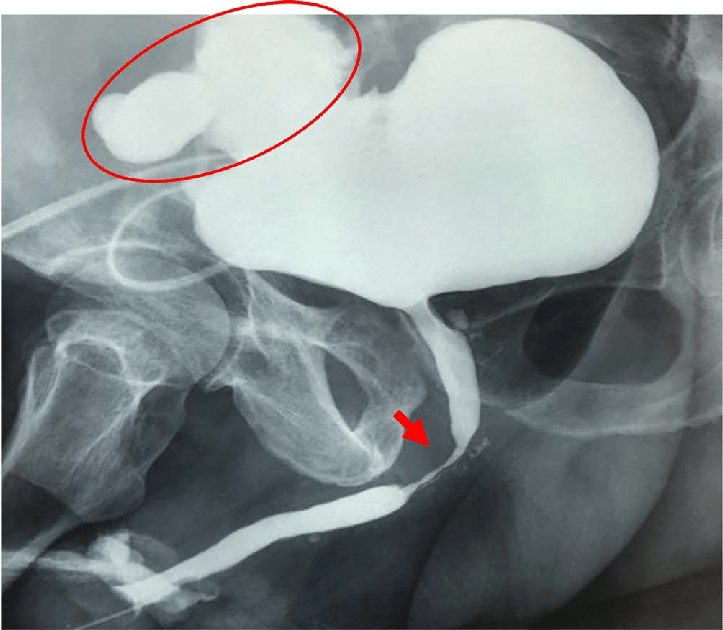
Patient will present as → a 56-year-old male with pain during urination, decreased urinary stream, and incomplete bladder emptying. Uroflowmetry demonstrates poor bladder emptying and a low peak rate of urine flow. Urethral Stricture is a narrowing of the urethra caused by injury, instrumentation (TURP), infection (typically with gonorrhea), and certain non-infectious forms of urethritis
- Presents with weak urinary stream, difficulty urinating, incomplete bladder emptying, and recurrent urinary tract infections
- May cause urinary retention, bladder stones, or hydronephrosis if left untreated
- A urethral stricture should be suspected in men with chronic obstructive voiding symptoms, especially if noninvasive studies (e.g., uroflowmetry, ultrasound postvoid residual measurement) demonstrate poor bladder emptying with a low peak rate of urine flow
DX: Patients suspected of having a urethral stricture should undergo cystourethroscopy, retrograde urethrogram (RUG) — gold standard, voiding cystourethrogram (VCUG), or ultrasound urethrography to establish the diagnosis
TX: Treatments include urethral dilation or stent placement
- An open urethroplasty is an option for longer, more severe strictures
 Image: Retrograde urethrocystography demonstrates a single stenosis of the bulbar urethra, which is tight and long, associated with a large diverticula of the bladder CC BY 4.0 |
Back to PANCE Blueprint Genitourinary (4%)