

 Lecture

To watch this and all of Joe-Gilboy PA-C's video lessons you must be a member. Members can log in here or join now.
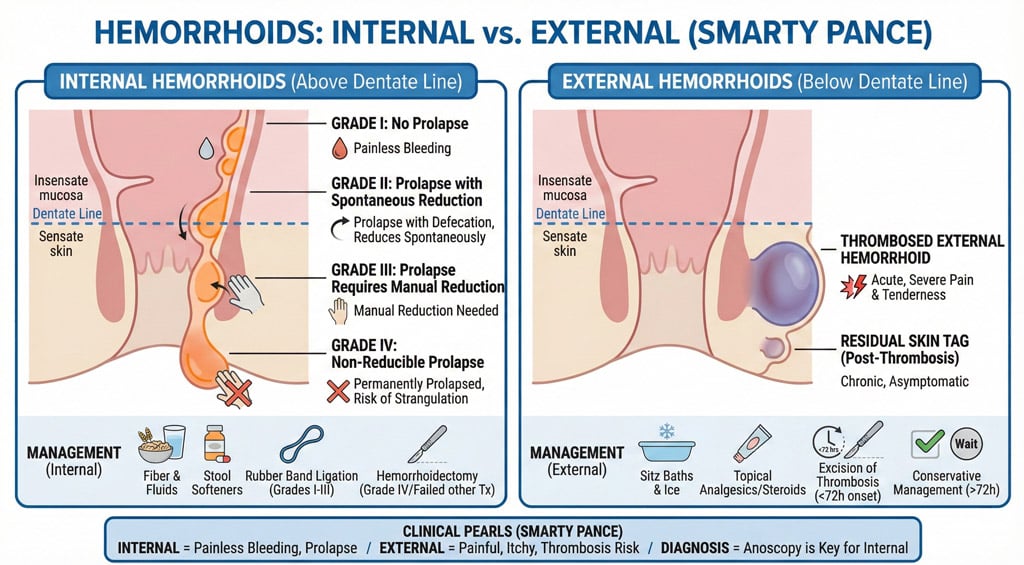
| Internal | External | |
|---|---|---|
| Location | Above the dentate line | Below the dentate line |
| Nerves | Visceral → painless | Somatic → painful |
| Classic finding | Painless bright red blood on the paper or in the bowl; prolapse | Acutely painful, bluish perianal lump (thrombosed); usually no bleeding |
| Grading | I–IV by prolapse | Not graded |
| Diagnosis | Anoscopy (can't be felt on DRE) | Inspection at the anal verge |
| Office treatment | Rubber band ligation (grade I–III) | Excision if thrombosed < 72 hours |
| First line for both | Fiber + fluids, sitz baths, short-course topical agents | |
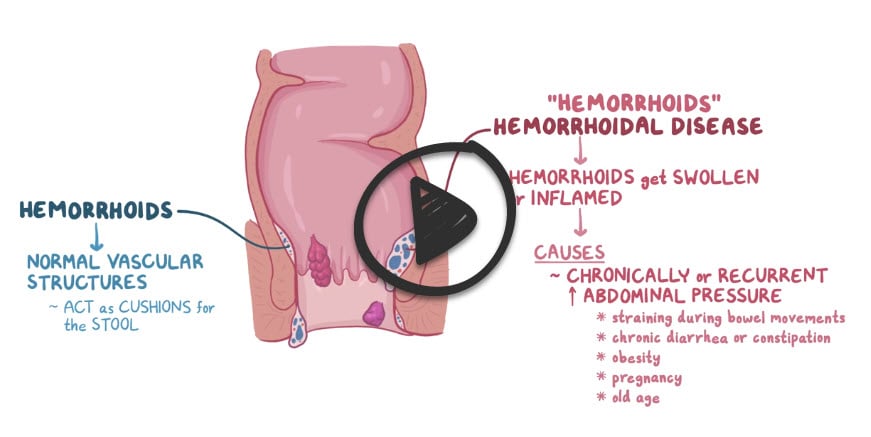
Hemorrhoids are normal vascular cushions (blood vessels, smooth muscle, and connective tissue) in the anal canal; hemorrhoidal disease is when they enlarge, slide down, bleed, or clot (they are not simply varicose veins)
- Risk factors: chronic constipation and straining, prolonged sitting on the toilet, pregnancy, chronic diarrhea, older age, and obesity (portal hypertension causes rectal varices, a different problem)
- Discomfort is a common symptom, especially during bowel movements or when sitting. Other symptoms include itching and bleeding
There are three types of hemorrhoids
- External hemorrhoids are distal to the dentate line
- Internal hemorrhoids are proximal to the dentate line
- Mixed hemorrhoids are located both proximal and distal to the dentate line

Internal hemorrhoids (above the dentate line): painless bright red blood per rectum (visceral nerves above the dentate line do not sense pain)
- Internal hemorrhoids typically manifest with bleeding after defecation; blood is noted on toilet tissue and sometimes in the toilet bowl
- Internal hemorrhoids may be uncomfortable but are not as painful as thrombosed external hemorrhoids
- Internal hemorrhoids sometimes cause mucus discharge and a sensation of incomplete evacuation
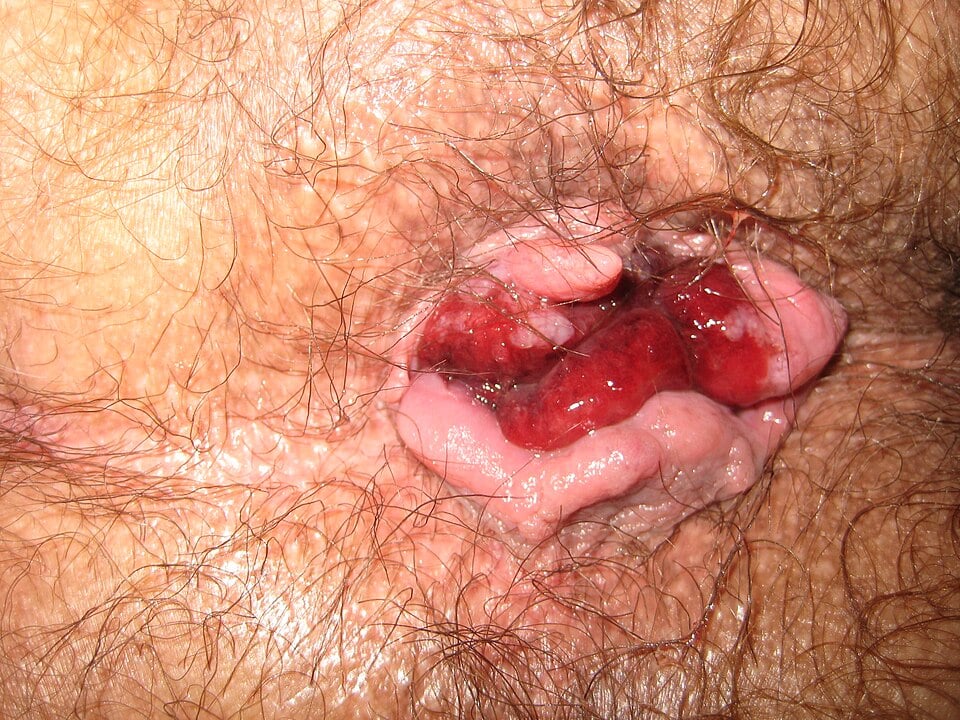
Grade IV internal Hemorrhoids. Image: Απόστολος Σταματιάδης, CC BY-SA 2.5, via Wikimedia Commons.
External hemorrhoids (below dentate line): painful when thrombosed (somatic nerves), usually no bleeding
- External hemorrhoids may become thrombosed, resulting in painful, purplish swelling
- Rarely they ulcerate and cause minor bleeding. Cleansing the anal region may be difficult
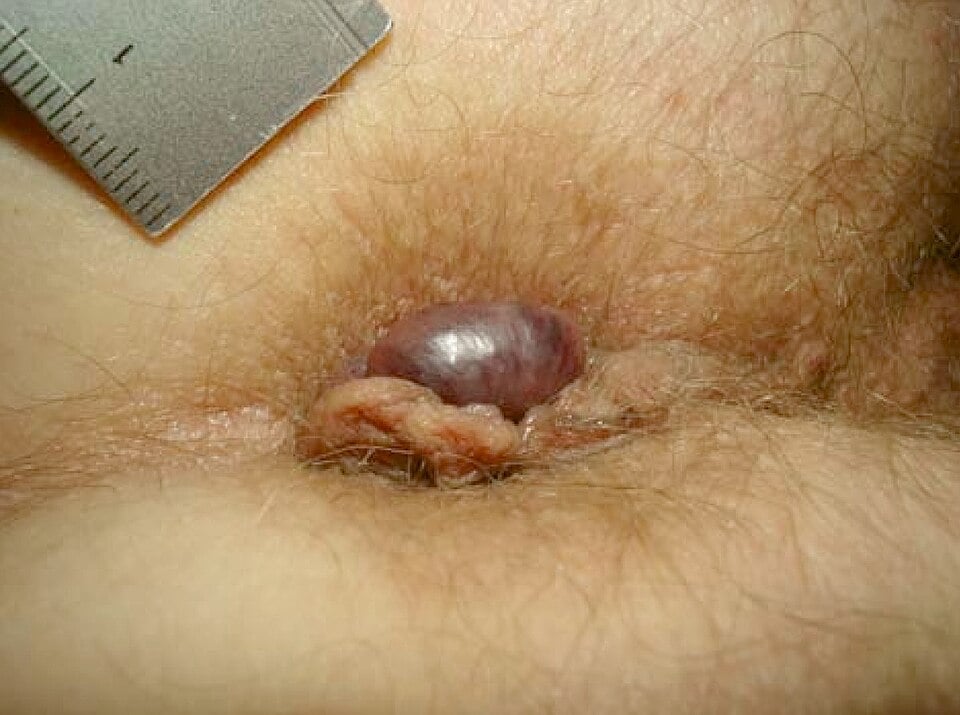
Thrombosed external hemorrhoid. Image: Ole Gebbensleben, York Hilger and Henning Rohde, CC BY 2.0, via Wikimedia Commons.
Strangulated hemorrhoids occur when protrusion and constriction occlude the blood supply. They cause pain that is occasionally followed by necrosis and ulceration.
Physical examination
- Inspection of the anal verge and perianal area for external hemorrhoids, prolapsed internal hemorrhoids, or other possible causes of anal symptoms (e.g., condylomata)
- Digital rectal examination (DRE) for palpation for masses, tenderness, and characterization of anal sphincter tone
Studies
- Anoscopy is the best way to see internal hemorrhoids (they cannot be felt on DRE unless thrombosed)
- Colonoscopy for bleeding at age 40 or older, and at any age with iron deficiency anemia, atypical bleeding, change in bowel habits, family history of colorectal cancer or IBD, or bleeding that persists after treatment; melena or dark blood → look for an upper GI source
Classification of internal hemorrhoids is based on the degree of prolapse
- Grade I: visualized via anoscopy; do not prolapse below the dentate line
- Grade II: prolapse out of the anal canal with defecation or straining but reduce spontaneously
- Grade III: prolapse out of the anal canal with defecation or straining and require manual reduction
- Grade IV: irreducible and may strangulate

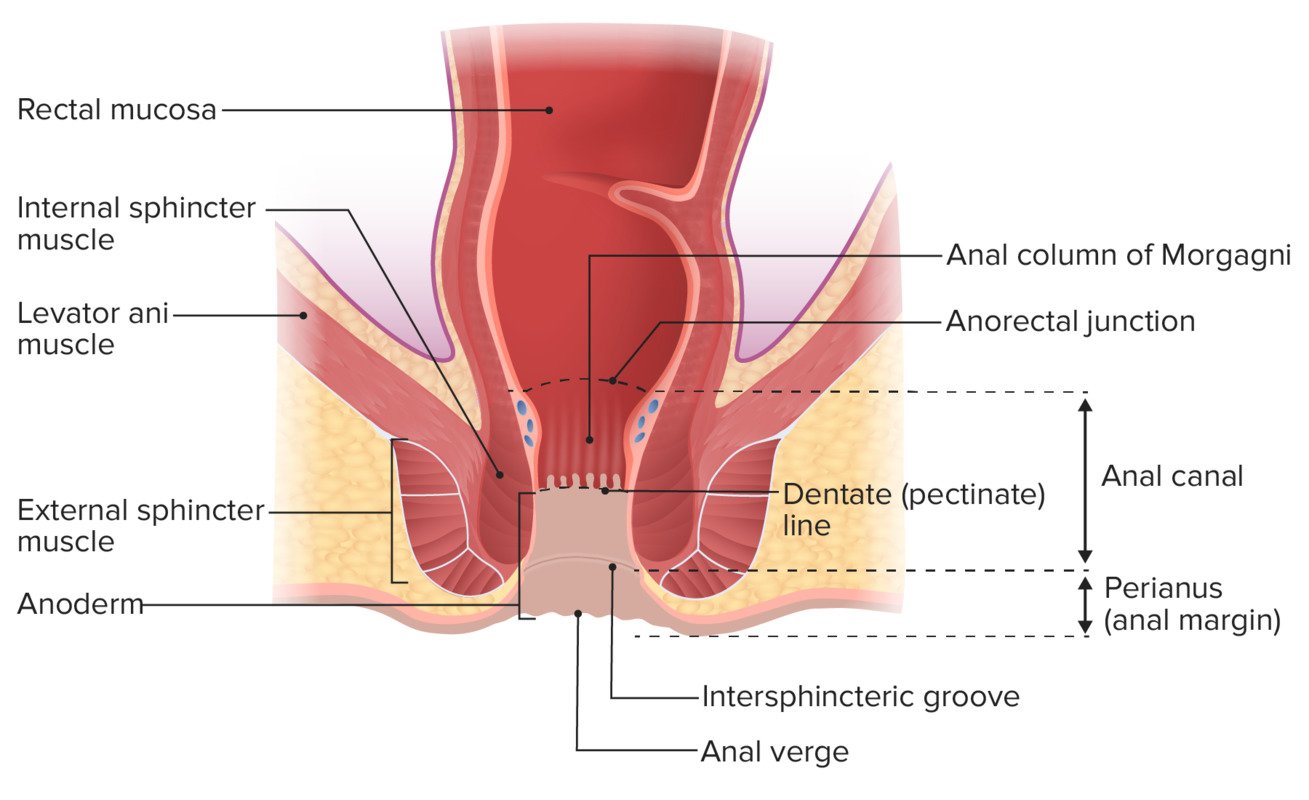
location of internal vs. external hemorrhoids. Image: BruceBlaus, CC BY 3.0, via Wikimedia Commons.
All patients: fiber first
- Fiber 20–30 g/day (e.g., psyllium) plus plenty of water; avoid straining and lingering on the toilet; warm sitz baths
- Short course (7 days or less) of topical hydrocortisone or a topical anesthetic (lidocaine) for symptoms; longer steroid use thins the skin
Internal hemorrhoids that fail conservative care (grade I–III)
- Rubber band ligation is the most effective office procedure; the band goes above the dentate line (painless area)
- Avoid banding with anticoagulants or P2Y12 inhibitors (e.g., clopidogrel), portal hypertension, or immunocompromise → sclerotherapy instead
- Pain, fever, and urinary retention after banding → think pelvic sepsis → urgent evaluation
- Surgical hemorrhoidectomy for grade IV, mixed internal and external disease, or failed banding
Thrombosed external hemorrhoid
- Seen within about 72 hours with severe pain → excision under local anesthesia (better than simple incision and clot evacuation, which tends to recur)
- After 72 hours or already improving → conservative care (sitz baths, NSAIDs, soft stools); it resolves over 7–10 days
- Never band external hemorrhoids
 Osmosis |
|
 |
Question 1 |
Above the dentate line, in mucosa with visceral innervation | |
Below the dentate line, in anoderm with somatic innervation Hint: Lesions below the dentate line (external hemorrhoids, fissures) have somatic pain fibers, so they hurt; this patient has no pain. | |
In an obstructed anal crypt gland Hint: An infected anal crypt gland causes an abscess with constant, throbbing pain and a tender mass. | |
In the perianal skin lateral to the anal verge Hint: Perianal skin lesions are visible on inspection and are innervated by somatic nerves. | |
In the posterior midline anoderm Hint: A posterior midline fissure causes tearing pain with each bowel movement that lasts for hours. |
Question 2 |
Anoscopy | |
Barium enema Hint: Barium enema is not used to evaluate bright red rectal bleeding and cannot see the anal canal well. | |
Colonoscopy Hint: Colonoscopy is for hemorrhoidal bleeding at age 40 or older, or at any age with red flags such as anemia, atypical bleeding, or a family history; she has none. | |
CT of the abdomen and pelvis Hint: CT does not show internal hemorrhoids and adds radiation without benefit. | |
Fecal immunochemical test Hint: A stool blood test is a screening test for average-risk adults; it adds nothing when visible bleeding is already present. |
Question 3 |
Hemorrhoidectomy Hint: Surgery is reserved for grade IV, mixed internal and external disease, or hemorrhoids that fail office procedures. | |
Increased dietary fiber and water intake | |
Infrared coagulation Hint: Office procedures such as infrared coagulation are for hemorrhoids that remain symptomatic despite conservative care. | |
Rubber band ligation Hint: Banding is the most effective office procedure, but only after conservative care fails. | |
Topical hydrocortisone for 4 weeks Hint: Topical steroids are limited to 7 days or less because longer use thins the perianal skin. |
Question 4 |
Excisional hemorrhoidectomy Hint: Surgical hemorrhoidectomy is for grade IV disease, mixed internal and external disease, or failure of banding. | |
Oral metronidazole Hint: Antibiotics have no role in uncomplicated hemorrhoids. | |
Rubber band ligation | |
Topical hydrocortisone for 4 weeks Hint: Topical steroids are limited to 7 days or less and do not fix prolapsing hemorrhoids. | |
Topical nitroglycerin Hint: Topical nitroglycerin relaxes the internal sphincter and is used for anal fissures. |
Question 5 |
Excisional hemorrhoidectomy Hint: Surgery is not needed for grade II disease and carries more bleeding risk in an anticoagulated patient. | |
Rubber band ligation Hint: Banding is avoided in patients on anticoagulants because of the risk of serious delayed bleeding when the band falls off. | |
Sclerotherapy | |
Stapled hemorrhoidopexy Hint: Stapled hemorrhoidopexy is an operating room procedure for larger prolapsing hemorrhoids, not a first office option. | |
Topical hydrocortisone for 4 weeks Hint: Topical steroids are limited to 7 days or less and do not control ongoing bleeding. |
Question 6 |
Excision of the thrombosed hemorrhoid under local anesthesia | |
Oral ciprofloxacin and metronidazole Hint: Antibiotics do not treat a clotted external hemorrhoid; there is no abscess. | |
Rubber band ligation Hint: External hemorrhoids are below the dentate line, where banding would be extremely painful; never band them. | |
Sclerotherapy Hint: Sclerotherapy is used for internal hemorrhoids above the dentate line. | |
Topical nitroglycerin Hint: Topical nitroglycerin is a treatment for anal fissure. |
|
List |
References: Merck Manual · UpToDate