

 Lecture


2 y/o with cough and stridor
Patient will present as → a 2-year-old male is brought to the emergency department by his parents due to a 2-day history of low-grade fever, nasal congestion, and a “barking cough" that worsened at night. Today, he developed stridor at rest and increasing respiratory distress. His temperature is 100.8°F (38.2°C), and he appears anxious with mild intercostal retractions. On auscultation, lung fields are clear but inspiratory stridor is audible. A soft tissue neck X-ray reveals subglottic narrowing ("steeple sign"). He is diagnosed with viral croup, likely due to parainfluenza virus. Management includes nebulized racemic epinephrine and dexamethasone, with observation for worsening symptoms. Parents are advised on supportive care, signs of respiratory distress, and when to return to the hospital.


To watch this and all of Joe-Gilboy PA-C's video lessons, you must be a member. Members can log in here or join now.
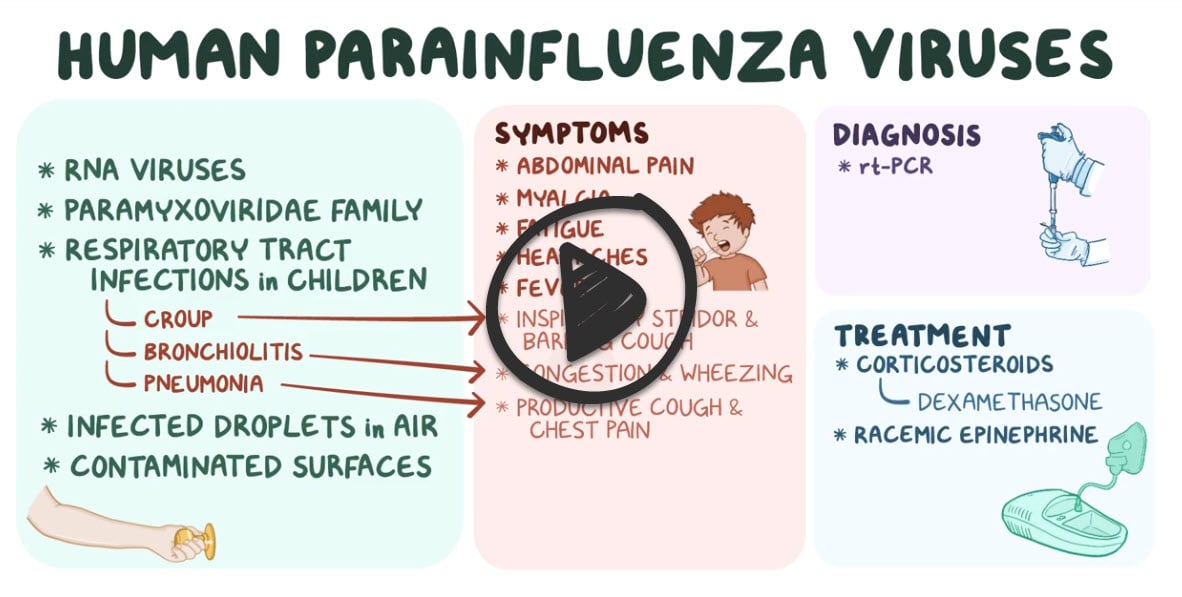
Croup is caused by parainfluenza virus
- Commonly in children 6 months - 3 years of age
- Fall and early winter months (same time of year as bronchiolitis)
- Barking cough and stridor
Diagnosis is clinical, but AP neck X-ray may show the classic “steeple sign” (narrowing of the trachea in the subglottic region)
- The Westley Croup Score is often used to objectively assess severity

AP x-ray of the neck in a child with croup demonstrating the steeple sign (narrowing of the trachea)
Mild cases are treated with humidified air or cool mist, and single-dose oral dexamethasone
- Moderate to severe cases (stridor at rest or respiratory distress) require nebulized epinephrine and close monitoring
- Hospitalization is considered for patients with worsening symptoms, poor oral intake, or hypoxia
- Prognosis is excellent—complications include respiratory failure and secondary bacterial tracheitis, though rare
 Osmosis Osmosis |
|
 |

Croup is a general term that describes a group of conditions characterized by edema and inflammation of the upper airway. The focus of this Picmonic is on the most common croup disorder – laryngotracheobronchitis, often abbreviated as LTB, which often leads to hospitalization. The other group disorders are acute epiglottitis, acute spasmodic laryngitis, and acute tracheitis.
Play Video + QuizPicmonic Parainfluenza Virus

Parainfluenza virus is a single-stranded RNA paramyxovirus that causes croup in children. Croup is an upper respiratory infection that presents with respiratory difficulty and a characteristic barking cough. In adults, it causes mild upper respiratory infections. However, parainfluenza infections can cause inflammation and swelling in the upper airway to the point of obstruction in children. Severe cases present with inspiratory stridor, and airway swelling can be seen on a frontal neck X-Ray indicated by a steeple sign. These cases require immediate medical intervention.
Play Video + QuizQuestion 1 |
drooling Hint: Drooling and a "hot potato" voice are seen with epiglottitis, not viral croup. | |
high fever Hint: Fever is usually absent or low grade in patients with viral croup. | |
"hot potato" voice Hint: See A for explanation. | |
barking cough |
Question 2 |
Intravenous antibiotics Hint: Laryngotracheobronchitis is caused by viruses, not bacteria, and therefore antibiotic therapy is not indicated. | |
Endotracheal intubation Hint: If patients fail to respond to initial treatment and progress to impending respiratory failure, endotracheal intubation is then indicated. | |
Inhaled mucolytic agent Hint: Inhaled mucolytic agents are not indicated in the treatment of laryngotracheobronchitis. | |
Nebulized racemic epinephrine |
Question 3 |
Nebulized albuterol Hint: Viral croup is an upper airway disease and there is no role for bronchodilator therapy. | |
Nebulized epinephrine Hint: Nebulized racemic epinephrine is only indicated in the treatment of croup in cases of moderate to severe rest stridor, respiratory distress, or hypoxia. | |
Oral amoxicillin Hint: Croup is almost always a viral illness and antibiotics have no role in the treatment of this condition. | |
Oral dexamethasone |
Question 4 |
Rubeola virus Hint: See D for explanation. | |
Adenovirus Hint: See D for explanation. | |
Influenza virus Hint: See D for explanation. | |
Parainfluenza virus |
|
List |
References: Merck Manual · UpToDate