

 Picmonic
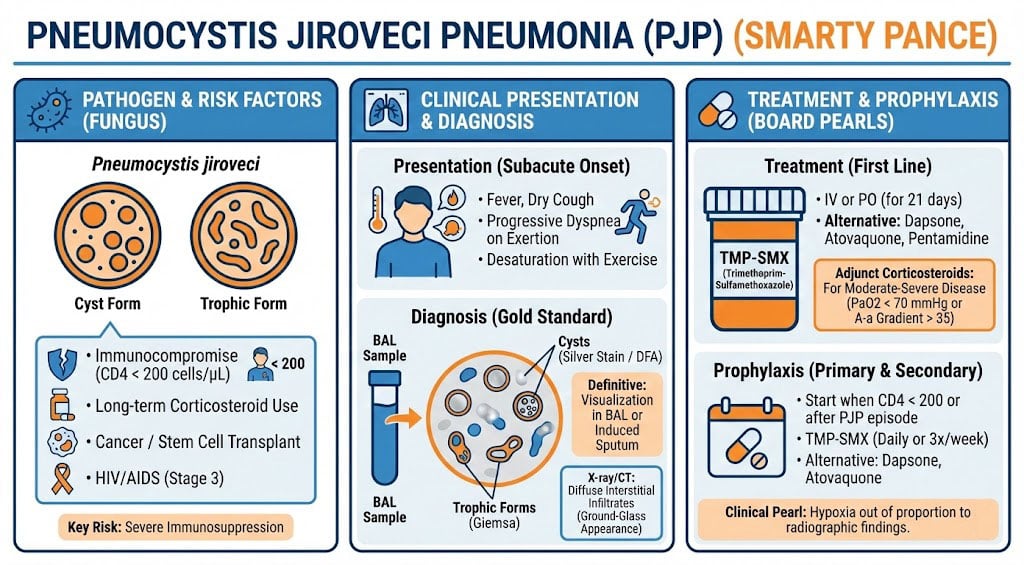
Patient will present as → a 32-year-old male with dyspnea and a nonproductive cough. He is tachycardic, tachypneic and febrile. Auscultation of his chest reveals scattered rhonchi. His chest x-ray demonstrates a diffuse interstitial infiltrate. His ABG demonstrates moderate hypoxemia, and his LDH is elevated.
Formerly PCP Pneumonia, now called (PJP) Pneumocystis jiroveci (there are other HIV-related pneumonias, but this is the one you will need to know for the test)
- Common in HIV-infected patients with a low CD4 count of less than 200
CXR is the cornerstone of diagnosis. The radiograph shows diffuse interstitial or bilateral perihilar infiltrates
- Diagnose with bronchoalveolar lavage (BAL) (GOLD STANDARD) (by PCR), labs, and an HIV test
- Methenamine silver stain is used to stain Pneumocystis. Samples of affected tissue, such as lung tissue from a biopsy, can be stained to reveal the pathogen
- Will often have very low O2 saturation despite supplemental O2
Treat with Trimethoprim-sulfamethoxazole (BACTRIM) and steroids if PaO₂ <70 mmHg on room air
- If allergic or intolerant to TMP-SMX (severity-based alternatives)
- Moderate-to-Severe Disease: Primaquine + Clindamycin (Preferred over IV Pentamidine due to better safety profile)
- Mild-to-Moderate Disease: Atovaquone or Dapsone + Trimethoprim
Prophylaxis for high-risk patients with a CD4 count <200 cells/µL or with a history of prior PJP infection
- Daily Bactrim is the prophylaxis antibiotic of choice

These chest radiographs are of two patients. Both show a ground-glass appearance. The left chest X-ray (CXR) shows a much more subtle ground-glass appearance, while the right CXR shows a much more gross ground-glass appearance mimicking pulmonary edema.

Pneumocystis jiroveci is a fungal infection which typically presents with hypoxia and fever in the lungs of immunocompromised patients. The infection is usually diagnosed using classic x-ray findings of diffuse interstitial infiltration bilaterally. Definitive diagnosis can be made using lavage or biopsy, were it can be identified by methenamine on silver stain. In order to prevent the disease in patients with HIV and CD4 counts below 200, TMP-SMX is used prophylactically. TMP-SMX is also used as treatment for diagnosed disease.
Play Video + QuizQuestion 1 |
Trimethoprim-Sulfamethoxazole (Bactrim) | |
Tetracycline (Sumycin) Hint: Tetracycline, amantadine, and ticarcillin are not effective against PCP. | |
Amantadine (Symmetrel) Hint: Tetracycline, amantadine, and ticarcillin are not effective against PCP. | |
Ticarcillin (Ticar) Hint: Tetracycline, amantadine, and ticarcillin are not effective against PCP. |
Question 2 |
Blood cultures | |
Bronchoalveolar lavage with methenamine silver staining | |
CT pulmonary angiography | |
Nasopharyngeal viral PCR | |
Sputum acid-fast bacilli smear |
Question 3 |
Azithromycin | |
Fluconazole | |
Isoniazid | |
Trimethoprim-sulfamethoxazole | |
Valganciclovir |
|
List |
References: Merck Manual · UpToDate