


Patient will present with → a 6-month-old boy brought to the clinic by his mother, who is worried about his persistent and severe coughing episodes that have been ongoing for two weeks. She describes the cough as initially mild but has since progressed to intense bouts followed by a high-pitched "whooping" sound when he takes a breath. These episodes often lead to vomiting and have been particularly distressing at night. The mother also mentions that her son had a mild fever and runny nose before the cough started. On examination, the infant has clear lung sounds between coughing fits, but during an episode, inspiratory whoops can be heard. A nasopharyngeal swab is taken for further testing. (watch video)
Patient will present as → a 24-year-old with an increasing cough for 3 weeks. The cough comes and goes, sometimes lasting for 10 minutes and causing gasping inhalations. The cough was preceded by a mild cough and cold 2 weeks ago. She has no known drug allergies. The patient's immunizations are not up-to-date. (alternate presentation)
Caused by the highly contagious gram-negative bacteria Bordetella Pertussis
- Consider pertussis in adults with cough > 2 weeks
- Unvaccinated individuals or those whose vaccinations are not up-to-date
- Symptoms are initially those of nonspecific upper respiratory infection (catarrhal stage ) followed by paroxysmal or spasmodic coughing that usually ends in a prolonged, high-pitched, crowing inspiration (the whoop)
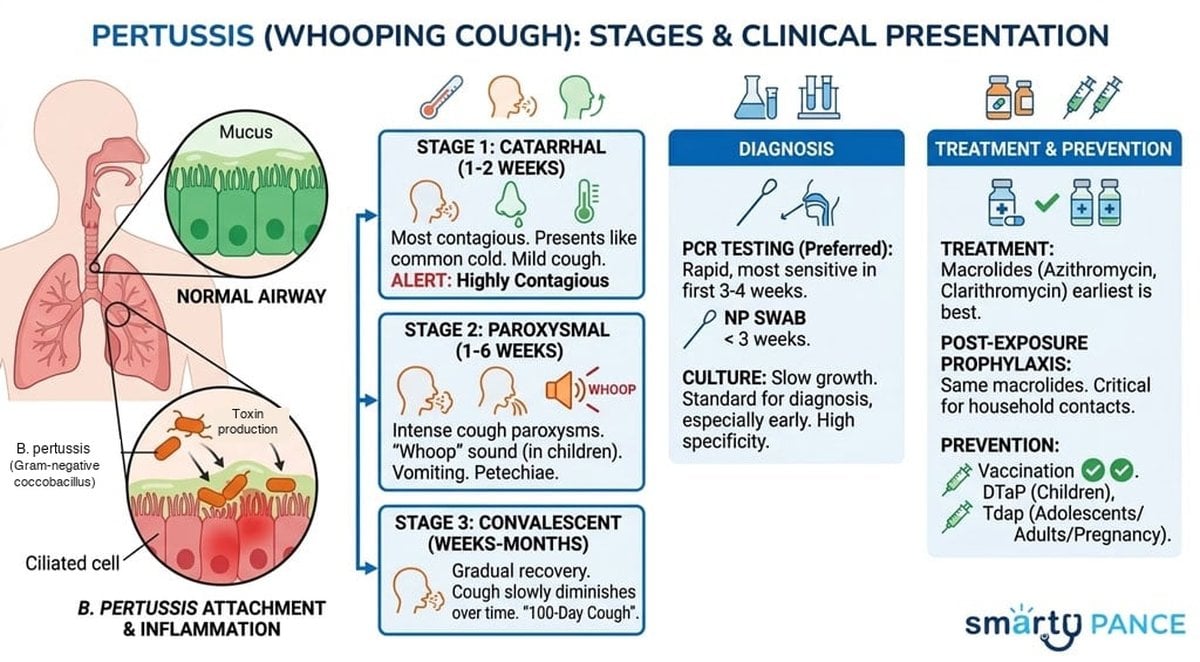
Diagnosis is confirmed by PCR of a nasopharyngeal swab or aspirate (preferred; culture is the most specific but less sensitive)
- In the setting of a pertussis outbreak or known close contact with a confirmed case, the presence of a cough lasting ≥ 2 weeks is sufficient for clinical diagnosis (even in the absence of other symptoms)
- For patients with less than two weeks of cough in whom there is a clinical concern for pertussis, perform both culture and PCR for B. pertussis
- For patients with two to four weeks of cough, perform both culture and PCR
- For patients with more than four weeks of cough, only serology is useful
Treat with a macrolide antibiotic - azithromycin is preferred at all ages (the only choice under 1 month); clarithromycin or erythromycin are alternatives
- Trimethoprim/sulfamethoxazole may be substituted in patients ≥ 2 months who cannot tolerate macrolides
- Supportive care includes hydration and nutrition; cough suppressants, steroids and beta2 agonists do not help

"What do you do if your patient is a 4-year-old diagnosed with pertussis and attends a daycare? Treat the child with azithromycin and keep him out of daycare until he has completed 5 days of antibiotics. Give azithromycin prophylaxis to all household contacts, regardless of age, vaccination status, or symptoms; at daycare, prophylaxis is aimed at high-risk contacts (infants younger than 1 year, pregnant women, immunocompromised children) and the people who care for them."
Postexposure Antimicrobial Prophylaxis CDC Guidelines
Children should get 5 doses of the DTaP vaccine: one dose at each of the following ages:
- 2 months
- 4 months
- 6 months
- 15–18 months
- 4–6 years
Adolescents should receive one dose of Tdap at age 11–12 years
- Adults should receive one lifetime dose of Tdap (if not previously given), followed by Td or Tdap booster every 10 years
- Pregnant patients should receive Tdap during every pregnancy at 27–36 weeks (regardless of prior vaccination)
- Children ages 7–10 years who are not fully immunized should receive Tdap as part of catch-up vaccination
- Tdap can be given regardless of interval since last Td (no minimum spacing required)
 Osmosis |
|
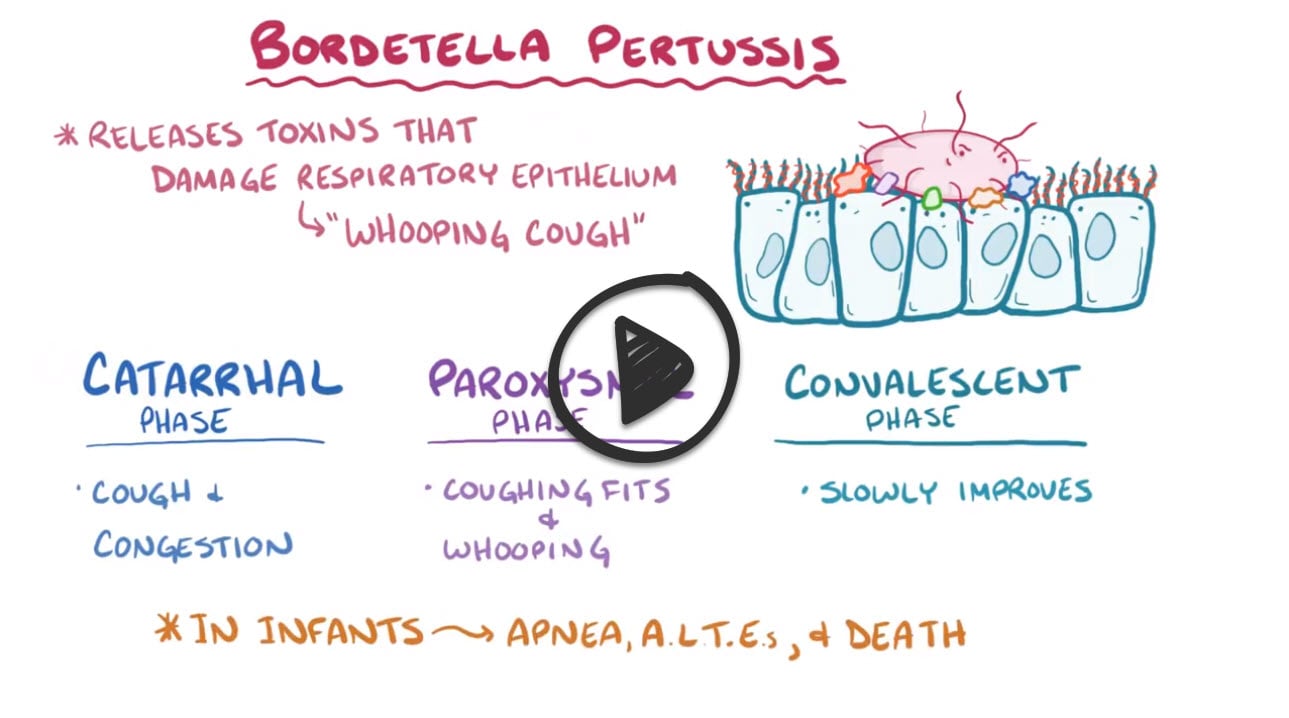 |
Bordetella pertussis is a gram-negative coccobacillus that is the causative agent of whooping cough. This organism is typically cultured on specialized medium called Bordet Gengou agar. Bordetella pertussis produces the pertussis toxin, which is an ADP ribosylating AB toxin that is involved in the colonization of the respiratory tract and the establishment of infection. This toxin catalyzes the ADP ribosylation of the Gi subunit, which prevents the G proteins from interacting with G protein coupled receptors on the cell membrane. The Gi subunits remain locked in an inactive or off state and are therefore unable to inhibit adenylyl cyclase activity leading to increased concentrations of cAMP. The increase in intracellular cAMP has several systemic effects including lymphocytosis and an increase in insulin leading to hypoglycemia.
The first 1-2 weeks of infection is typically called the catarrhal phase. The patient is usually most contagious during this stage of infection and signs and symptoms include nasal congestion, rhinorrhea, sneezing, and a low-grade fever. The catarrhal phase is followed by a paroxysmal phase which occurs during weeks 2-5 of infection. The paroxysmal phase is characterized by paroxysms of intense coughing lasting up to several minutes, occasionally followed by a loud inspiratory whooping sound, characteristic of this infection. Antibiotic use can hasten the eradication of the bacteria and help prevent spread. Azithromycin is one of the preferred agents.
Play Video + QuizQuestion 1 |
Pertussis cases are rising in the United States despite high childhood vaccination rates. Which of the following is the most important reservoir for transmitting Bordetella pertussis to unvaccinated infants?
Adolescents and adults with waning immunity | |
Contaminated drinking water Hint: Pertussis spreads by respiratory droplets, not water. | |
Dogs and cats Hint: Bordetella bronchiseptica causes respiratory infection in dogs and cats; B. pertussis has no animal reservoir. | |
Mosquitoes Hint: Pertussis is not transmitted by insects. | |
Unpasteurized milk Hint: Unpasteurized milk transmits Brucella, Listeria and others, not pertussis. |
Bordetella pertussis is a gram-negative coccobacillus spread by respiratory droplets; humans are the only host. Neither the vaccine (acellular DTaP/Tdap) nor natural infection gives lifelong immunity, so adolescents and adults with waning immunity, who often have only a prolonged cough, are the main source of infection for young infants, who have the highest rates of hospitalization and death. Prevention: DTaP at 2, 4, 6 and 15 to 18 months and 4 to 6 years, Tdap at 11 to 12 years, Tdap during every pregnancy (27 to 36 weeks) to protect the newborn, and Tdap for adults who never received it.
Question 2 |
A 3-month-old infant has 10 days of paroxysmal coughing spells that end with a high-pitched inspiratory "whoop" and post-tussive vomiting. She had cold symptoms the week before. White blood cell count is 24,000/µL with 75% lymphocytes. Which of the following is the most appropriate test to confirm the diagnosis?
Blood culture Hint: B. pertussis does not cause bacteremia, and blood cultures are not useful. | |
Chest radiograph Hint: A chest radiograph is usually normal or shows nonspecific changes and does not confirm pertussis. | |
Cold agglutinin titer Hint: Cold agglutinins are nonspecific and were once used for Mycoplasma. | |
Nasopharyngeal swab for Bordetella pertussis PCR | |
Throat swab culture on blood agar Hint: B. pertussis needs special media (Regan-Lowe or Bordet-Gengou) and a nasopharyngeal, not throat, specimen. |
Pertussis is confirmed with a nasopharyngeal swab or aspirate for PCR, which is most sensitive in the first 3 to 4 weeks of cough; culture on Regan-Lowe or Bordet-Gengou media is specific but less sensitive and slower. Serology is used later in illness. Stages: catarrhal (1 to 2 weeks of cold symptoms, most contagious), paroxysmal (2 to 6 weeks of coughing fits, whoop, post-tussive emesis; young infants may have apnea or cyanosis instead of a whoop) and convalescent (weeks to months). Marked lymphocytosis is a classic clue. Consider pertussis in any adult with cough lasting 2 weeks or more with paroxysms, whoop or post-tussive vomiting.
Question 3 |
A 4-month-old infant is brought to the clinic by his mother with complaints of a cough for the past 3 weeks. Initially, symptoms included runny nose, sneezing and an irritating cough. Over the past week the cough has changed to persistent staccato, paroxysmal forceful coughs ending with a loud inspiration. White blood cell count is 20,000/µL with 72% lymphocytes. Which of the following is the most appropriate pharmacologic therapy?
Amoxicillin Hint: Amoxicillin does not eradicate Bordetella pertussis; beta-lactams are not effective for pertussis. | |
Ampicillin Hint: Ampicillin is not a recommended treatment for pertussis. For patients 2 months or older who cannot take a macrolide, trimethoprim-sulfamethoxazole (TMP-SMX) is the alternative. | |
Azithromycin | |
Ceftriaxone Hint: Ceftriaxone does not eradicate Bordetella pertussis. | |
Gentamicin Hint: Gentamicin does not eradicate Bordetella pertussis. |
Beta-lactams (ampicillin, amoxicillin, ceftriaxone) and aminoglycosides do not reliably eradicate B. pertussis. For patients 2 months or older who cannot take a macrolide, trimethoprim-sulfamethoxazole is the alternative.
Question 4 |
A 4-year-old boy is diagnosed with pertussis by PCR. He lives with his parents, his 30-year-old aunt who is 32 weeks pregnant, and a 2-month-old brother. Everyone in the household is up to date on vaccines. Which of the following is the most appropriate management for the household contacts?
Azithromycin only for those who develop a cough Hint: Waiting for symptoms misses the window to prevent spread; contacts are treated before symptoms appear. | |
Azithromycin postexposure prophylaxis for all household members | |
Booster Tdap only, without antibiotics Hint: Vaccination does not prevent disease after exposure; household contacts need antibiotic prophylaxis regardless of vaccination status (a Tdap catch-up dose may also be given if due). | |
Observation, because all contacts are fully vaccinated Hint: Immunity wanes, so vaccinated contacts can still be infected and transmit pertussis to the infant. | |
Prophylaxis only for the 2-month-old infant Hint: All household contacts receive prophylaxis, not only the infant. |
Postexposure prophylaxis for pertussis is given to all household contacts and to other close contacts at high risk of severe disease or who will be around high-risk people (infants younger than 1 year, people in the third trimester of pregnancy, people with immunodeficiency or moderate-to-severe asthma, and those who care for them) — regardless of age or vaccination status, ideally within 3 weeks of exposure. The drugs and doses are the same as for treatment: azithromycin (preferred at all ages and the only choice under 1 month), clarithromycin or erythromycin, or TMP-SMX for those 2 months or older who cannot take a macrolide. Exposed people who are not up to date should also be vaccinated.
|
List |
References: Merck Manual · UpToDate