


Patient with emphysema will present as → a 65-year-old male complaining of fatigue and shortness of breath with exertion. The patient reports minimal cough. On physical exam, you note a thin, barrel-chested man with decreased heart and breath sounds, pursed-lip breathing, end-expiratory wheezing, and scattered rhonchi. Chest X-ray reveals a flattened diaphragm, hyperinflation, and a small, thin-appearing heart. PFTs show a decreased FEV1/FVC ratio.
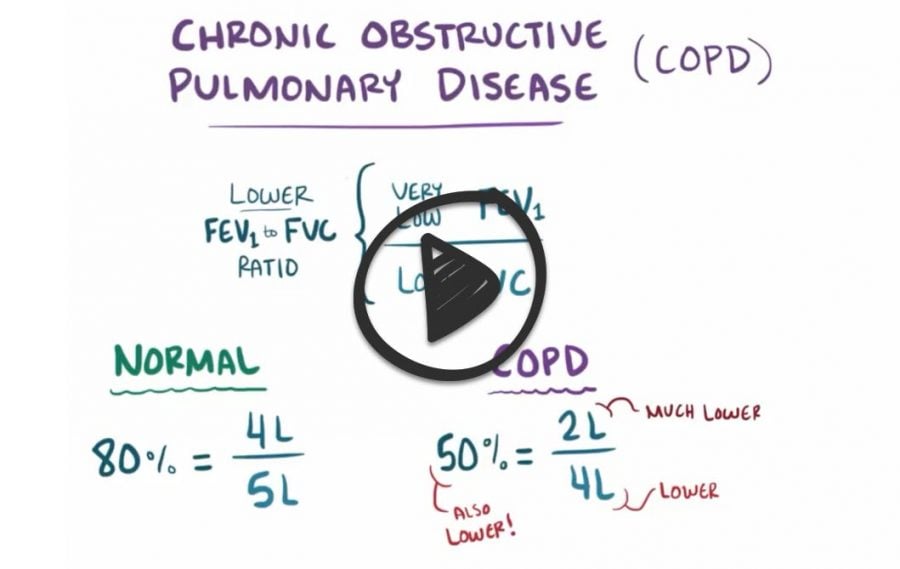
Spirometry is required to confirm COPD: a post-bronchodilator FEV1/FVC <0.70 establishes persistent airflow limitation that is not fully reversible (the key distinction from asthma).
GOLD grades severity by post-bronchodilator FEV1 (% predicted):
- GOLD 1 (mild): FEV1 ≥80%
- GOLD 2 (moderate): FEV1 50–79%
- GOLD 3 (severe): FEV1 30–49%
- GOLD 4 (very severe): FEV1 <30%
Supportive: a reduced DLCO reflects the alveolar destruction of emphysema.
Emphysema is a form of COPD due to structural changes in the lung - air spaces are enlarged as a consequence of the destruction of alveolar septae
- Chronic bronchitis and emphysema almost always coexist
- Chronic bronchitis (clinical features - a productive cough) vs. Emphysema (structural changes - enlarged airspaces)
- Loss of elastin → Lungs are more compliant (lungs expand, hold air)
- Alveolar air sacs permanently enlarge and lose elasticity → exhaling is difficult
Dyspnea and shortness of breath due to decreased gas exchange cause patients to exhale slowly through pursed lips to increase pressure in airways to keep airways from collapsing
- Individuals are able to oxygenate blood (pink), but they have to purse their lips to do so (puffers) = Pink Puffers!
- Alveoli are destroyed
- Barrel chest due to air trapping and hyperinflation of lungs
- Near-normal PaCO2 until late disease (they increase ventilation to blow off CO2); CO2 retention is typical of chronic bronchitis (blue bloaters)
- Hyperinflation with bullae is a consistent finding in patients with emphysema
- CXR reveals loss of lung markings and hyperinflation, tall lung fields, flat diaphragms
- Normal hematocrit (HCT)
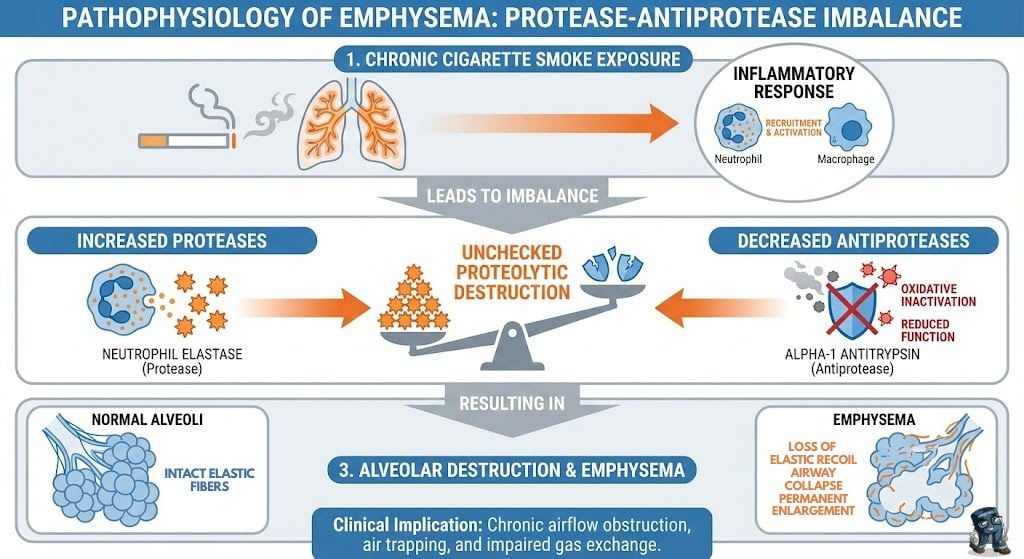

"The underlying mechanism of emphysema involves a disruption of the protease-antiprotease balance. Chronic exposure to tobacco smoke recruits inflammatory cells (neutrophils and macrophages), which release proteolytic enzymes, specifically neutrophil elastase. Simultaneously, smoke inhibits alpha-1 antitrypsin, the enzyme responsible for neutralizing elastase. This imbalance leads to the destruction of elastin in the alveolar walls (septa), resulting in the permanent enlargement of airspaces, loss of elastic recoil, and air trapping."
CXR reveals loss of lung markings, hyperinflation, increased anterior-posterior diameter
- PFTs show a decreased FEV1/FVC ratio + increased TLC (due to air trapping)

The most effective therapy for most patients with emphysema is smoking cessation
- Treatment depends on severity: a combination of short-acting (SABA) or long-acting (LABA) beta 2 agonist and short-acting (SAMA) or long-acting (LAMA) muscarinic agent (also known as an anticholinergic agent) +/- inhaled glucocorticoids
- GOLD assessment groups (A / B / E) guide initial therapy: Group B (more symptoms) and Group E (frequent/severe exacerbations) begin LABA + LAMA dual bronchodilator therapy; Group A begins a single bronchodilator. Add an inhaled corticosteroid (triple therapy) when blood eosinophils are ≥300 cells/µL (consider if ≥100 with ongoing exacerbations; avoid when <100). Roflumilast (chronic bronchitis with FEV1 <50% plus exacerbations), azithromycin, and dupilumab (type 2 inflammation) are add-on options for selected exacerbators
- Long-term oxygen therapy in all patients with COPD who have chronic hypoxemia defined as (SpO2) ≤ 88%
- Vaccination against both influenza and pneumococcal disease
- COPD exacerbations are managed with systemic glucocorticoids, antibiotics (tailored to the likelihood of specific pathogens), and antiviral therapy when influenza is suspected
 Osmosis Osmosis |
|
 |

Emphysema is a form of chronic obstructive lung disease characterized by the destruction of alveolar walls. There are two main forms of emphysema. Centriacinar emphysema is the most common form and associated with many years of smoking. Panacinar emphysema is less common and associated with individuals with an alpha-1 antitrypsin deficiency. Overall, emphysema is characterized by increased elastase activity, increased lung compliance, enlargement of air spaces, and decreased recoil of the lungs. Individuals with emphysema are commonly called pink puffers and have increased anteroposterior diameter of the chest, often referred to as a barrel chest. They also commonly exhale through pursed lips which help keep their airways open during exhalation.
Play Video + QuizQuestion 1 |
Alpha-1 antitrypsin deficiency | |
Chronic asthma Hint: Asthma causes variable, largely reversible airflow obstruction; it does not cause lower-lobe panacinar emphysema in a young nonsmoker. | |
Cystic fibrosis Hint: Cystic fibrosis presents earlier with recurrent infections, upper-lobe bronchiectasis, and pancreatic insufficiency. | |
Idiopathic pulmonary fibrosis Hint: Idiopathic pulmonary fibrosis causes a restrictive pattern (normal or high FEV1/FVC) with basilar fibrosis in older adults. | |
Secondhand smoke exposure Hint: Smoke-related emphysema is centrilobular and upper-lobe predominant. |
Question 2 |
Arterial blood gas Hint: An arterial blood gas measures oxygenation and CO2 retention to judge severity; it does not diagnose airflow obstruction. | |
Chest CT Hint: CT can show emphysema but is not needed to diagnose COPD and does not measure airflow. | |
Chest radiograph Hint: A chest radiograph may show hyperinflation and flattened diaphragms, but it cannot confirm or stage COPD. | |
Pulse oximetry Hint: Pulse oximetry screens for hypoxemia and guides oxygen therapy but does not diagnose COPD. | |
Spirometry with a bronchodilator |
Question 3 |
Daily oral prednisone Hint: Long-term oral corticosteroids have no role in stable COPD and cause major side effects. | |
Inhaled corticosteroid alone Hint: An inhaled corticosteroid is never used alone in COPD; it is added only for exacerbations with eosinophils of 300 or more and raises pneumonia risk. | |
Long-acting beta-agonist plus long-acting muscarinic antagonist | |
Oral theophylline Hint: Theophylline is a weak bronchodilator with a narrow therapeutic window and is not first-line. | |
Roflumilast Hint: Roflumilast is an add-on for frequent exacerbations in chronic bronchitis with FEV1 below 50%. |
Question 4 |
High-flow oxygen to keep SpO2 at 100% Hint: Over-oxygenation worsens CO2 retention in COPD; the target SpO2 during an exacerbation is 88% to 92%. | |
Inhaled corticosteroid alone Hint: An inhaled corticosteroid alone does not treat an acute exacerbation and is never used as COPD monotherapy. | |
Intravenous aminophylline Hint: Methylxanthines such as aminophylline add side effects without benefit in exacerbations. | |
Observation without additional medication Hint: She has a moderate exacerbation with purulent sputum and needs systemic corticosteroids and an antibiotic, not observation. | |
Oral prednisone for 5 days plus an oral antibiotic |
Question 5 |
Chronic azithromycin Hint: Chronic azithromycin can reduce exacerbations in selected patients but has not been shown to prolong survival. | |
Daily inhaled corticosteroid Hint: Inhaled corticosteroids may reduce exacerbations in eosinophilic COPD but do not reliably improve survival and raise pneumonia risk. | |
Long-term oxygen therapy | |
Oral theophylline Hint: Theophylline offers modest bronchodilation and no survival benefit. | |
Pulmonary rehabilitation Hint: Pulmonary rehabilitation improves dyspnea, exercise capacity, and quality of life, but long-term oxygen is the therapy proven to lower mortality in chronic hypoxemia. |
Question 6 |
Annual influenza vaccination | |
Daily prophylactic amoxicillin Hint: Prophylactic antibiotics are not recommended for stable COPD; chronic azithromycin is reserved for selected patients with frequent exacerbations. | |
Home oxygen therapy Hint: Home oxygen is indicated only for resting hypoxemia (SpO2 88% or less, or PaO2 55 mmHg or less); his saturation is 93%. | |
Inhaled corticosteroid monotherapy Hint: An inhaled corticosteroid is never used alone in COPD. | |
Maintenance oral prednisone Hint: Maintenance oral corticosteroids are not recommended for stable COPD. |
|
List |
References: Merck Manual · UpToDate