

 Lecture



2 y/o with cough and stridor
Patient will present as → a 2-year-old male is brought to the emergency department by his parents due to a 2-day history of low-grade fever, nasal congestion, and a “barking cough" that worsened at night. Today, he developed stridor at rest and increasing respiratory distress. His temperature is 100.8°F (38.2°C), and he appears anxious with mild intercostal retractions. On auscultation, lung fields are clear but inspiratory stridor is audible. A soft tissue neck X-ray reveals subglottic narrowing ("steeple sign"). He is diagnosed with viral croup, likely due to parainfluenza virus. Management includes nebulized racemic epinephrine and dexamethasone, with observation for worsening symptoms. Parents are advised on supportive care, signs of respiratory distress, and when to return to the hospital.


To watch this and all of Joe-Gilboy PA-C's video lessons, you must be a member. Members can log in here or join now.
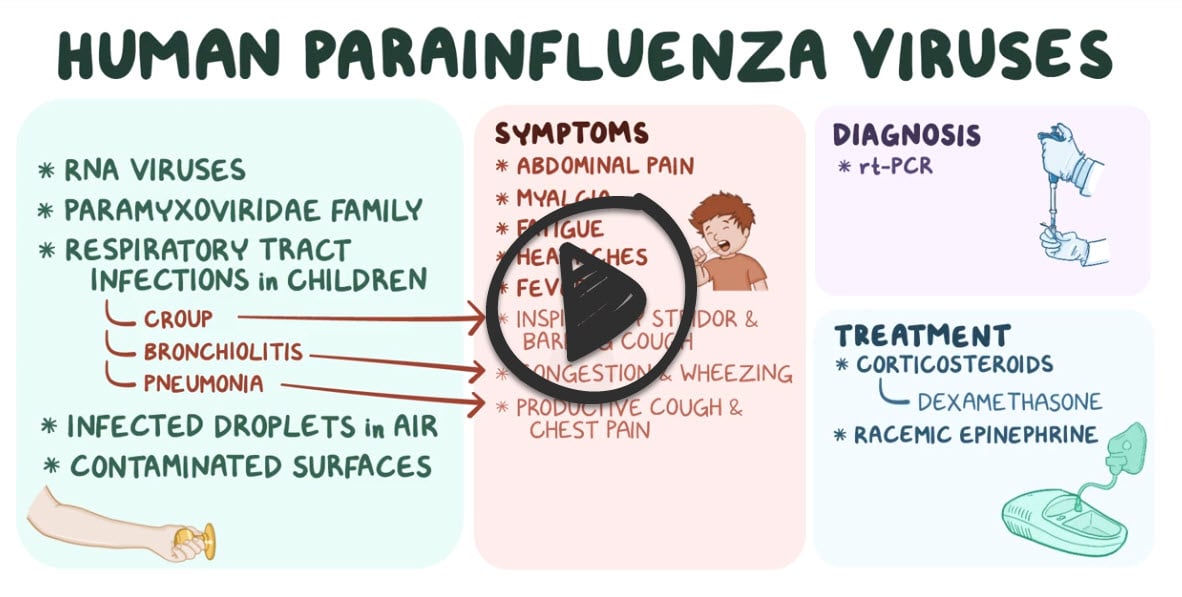
Croup is caused by parainfluenza virus
- Commonly in children 6 months - 3 years of age
- Fall and early winter months (same time of year as bronchiolitis)
- Barking cough and stridor
Diagnosis is clinical, but AP neck X-ray may show the classic “steeple sign” (narrowing of the trachea in the subglottic region)
- The Westley Croup Score is often used to objectively assess severity

AP x-ray of the neck in a child with croup demonstrating the steeple sign (narrowing of the trachea)
Mild cases are treated with single-dose oral dexamethasone and supportive care at home (fever control, fluids, a calm child); humidified air or cool mist has not been shown to help
- Moderate to severe cases (stridor at rest or respiratory distress) require nebulized racemic epinephrine plus dexamethasone, then observation for 2 to 4 hours for rebound
- Hospitalization is considered for patients with worsening symptoms, poor oral intake, or hypoxia
- Prognosis is excellent—complications include respiratory failure and secondary bacterial tracheitis, though rare
 Osmosis |
|
 |

Croup is a general term that describes a group of conditions characterized by edema and inflammation of the upper airway. The focus of this Picmonic is on the most common croup disorder – laryngotracheobronchitis, often abbreviated as LTB, which often leads to hospitalization. The other group disorders are acute epiglottitis, acute spasmodic laryngitis, and acute tracheitis.
Play Video + QuizPicmonic Parainfluenza Virus

Parainfluenza virus is a single-stranded RNA paramyxovirus that causes croup in children. Croup is an upper respiratory infection that presents with respiratory difficulty and a characteristic barking cough. In adults, it causes mild upper respiratory infections. However, parainfluenza infections can cause inflammation and swelling in the upper airway to the point of obstruction in children. Severe cases present with inspiratory stridor, and airway swelling can be seen on a frontal neck X-Ray indicated by a steeple sign. These cases require immediate medical intervention.
Play Video + QuizQuestion 1 |
An 18-month-old boy has 2 days of rhinorrhea and low-grade fever followed by a barking cough and hoarse voice that are worse at night. He has inspiratory stridor only when crying. Which of the following is the most likely cause?
Haemophilus influenzae type b Hint: Hib is the classic cause of epiglottitis: abrupt high fever, drooling, toxic appearance and no barking cough. | |
Parainfluenza virus | |
Respiratory syncytial virus Hint: RSV is the most common cause of bronchiolitis (wheezing, crackles), not barking cough with stridor. | |
Staphylococcus aureus Hint: S. aureus is the most common cause of bacterial tracheitis, which presents as a toxic child with high fever who does not respond to croup treatment. | |
Streptococcus pyogenes Hint: Group A strep causes pharyngitis and retropharyngeal abscess, not barking cough. |
Croup (laryngotracheobronchitis) is subglottic inflammation most often caused by parainfluenza virus (type 1), with RSV, influenza, adenovirus, SARS-CoV-2 and others less often. It affects children 6 months to 3 years (peak in fall and early winter). Classic features: a viral prodrome, then a barking (seal-like) cough, hoarseness and inspiratory stridor, typically worse at night. Fever is usually low grade, and the child does not look toxic or drool.
Question 2 |
A 2-year-old girl has a barking cough, hoarseness and inspiratory stridor that began after 2 days of cold symptoms. She is alert, nontoxic and not drooling. Which of the following is the most appropriate way to diagnose her condition?
Clinical diagnosis from history and examination | |
Direct laryngoscopy in the operating room Hint: Laryngoscopy is reserved for suspected epiglottitis, foreign body or atypical, recurrent or severe cases. | |
Lateral neck radiograph Hint: A lateral neck film is used when epiglottitis (thumbprint sign) or retropharyngeal abscess is suspected, not for typical croup. | |
Nasopharyngeal swab for viral PCR Hint: Identifying the virus does not change management of croup. | |
Posteroanterior chest radiograph Hint: Radiographs are not needed for typical croup; if obtained, an AP neck film may show subglottic narrowing (steeple sign). |
Croup is a clinical diagnosis, based on the age, viral prodrome, barking cough, hoarseness and stridor in a nontoxic child. Imaging is not routinely needed; if done for an atypical course, an anteroposterior neck radiograph may show subglottic narrowing, the steeple sign. Severity is judged by stridor at rest, retractions, agitation or lethargy and cyanosis. Think of other diagnoses if the child is toxic or drooling (epiglottitis, bacterial tracheitis), has a sudden onset without a prodrome (foreign body) or is older than 6 years.
Question 3 |
A 22-month-old boy has 1 day of barking cough after 3 days of cold symptoms. Temperature is 38.0°C (100.4°F). He has no stridor at rest; inspiratory stridor is heard only when he becomes agitated. There are no retractions or cyanosis. Which of the following is the most appropriate treatment?
Nebulized albuterol Hint: Viral croup is an upper airway disease and there is no role for bronchodilator therapy. | |
Nebulized racemic epinephrine Hint: Nebulized racemic epinephrine is only indicated in the treatment of croup in cases of moderate to severe rest stridor, respiratory distress, or hypoxia. | |
Oral amoxicillin Hint: Croup is almost always a viral illness and antibiotics have no role in the treatment of this condition. | |
Oral dexamethasone | |
Supportive care with humidified air only Hint: Humidified air or cool mist has not been shown to help croup; a single dose of dexamethasone is given even in mild cases. |
A single dose of oral dexamethasone (0.15 to 0.6 mg/kg) is given to every child with croup, including mild cases; it reduces return visits and hospitalization. Oral is as effective as IM. Mild croup (no stridor at rest) is then managed at home with fever control, fluids and keeping the child calm; humidified air or cool mist has not been shown to help. Nebulized racemic epinephrine is added only for stridor at rest or respiratory distress. Antibiotics and bronchodilators have no role.
Question 4 |
A 2-year-old boy is brought to the emergency department with a barking cough and stridor at rest. He has suprasternal and intercostal retractions but is alert, not drooling and not cyanotic. Oxygen saturation is 95% on room air. Which of the following is the most appropriate management?
Intravenous ceftriaxone and admission Hint: Croup is viral; antibiotics are indicated only for bacterial tracheitis or epiglottitis. | |
Lateral neck radiograph before any treatment Hint: Imaging is not needed for typical croup and should not delay treatment. | |
Nebulized racemic epinephrine plus oral dexamethasone, then observation for 2 to 4 hours | |
Oral dexamethasone and discharge home Hint: Dexamethasone alone is enough for mild croup, but stridor at rest with retractions also needs nebulized epinephrine and a period of observation. | |
Urgent endotracheal intubation Hint: Intubation is reserved for impending respiratory failure (fatigue, cyanosis, altered mental status) despite treatment. |
Moderate to severe croup (stridor at rest, retractions) is treated with nebulized racemic epinephrine plus dexamethasone. Epinephrine works within minutes but lasts about 2 hours, so the child is observed for 2 to 4 hours after the dose for a rebound before discharge. Admit if stridor at rest returns, more than one or two epinephrine doses are needed, or there is hypoxemia, dehydration or toxicity. Give oxygen if hypoxemic and keep the child calm in the parent's lap. A toxic child with high fever who does not respond suggests bacterial tracheitis (treat with vancomycin plus ceftriaxone).
|
List |
References: Merck Manual · UpToDate