


49 y/o with swelling and redness around the eye
Patient will present as → a 49-year-old man presents to the emergency department with a 2-day history of right eye pain, swelling, and decreased vision. On examination, he has proptosis, ophthalmoplegia (paralysis of the extraocular muscles), and chemosis of the right eye. His temperature is 101°F (38.3°C), and blood cultures are pending. A CT scan of the orbits shows evidence of an abscess in the right orbit.
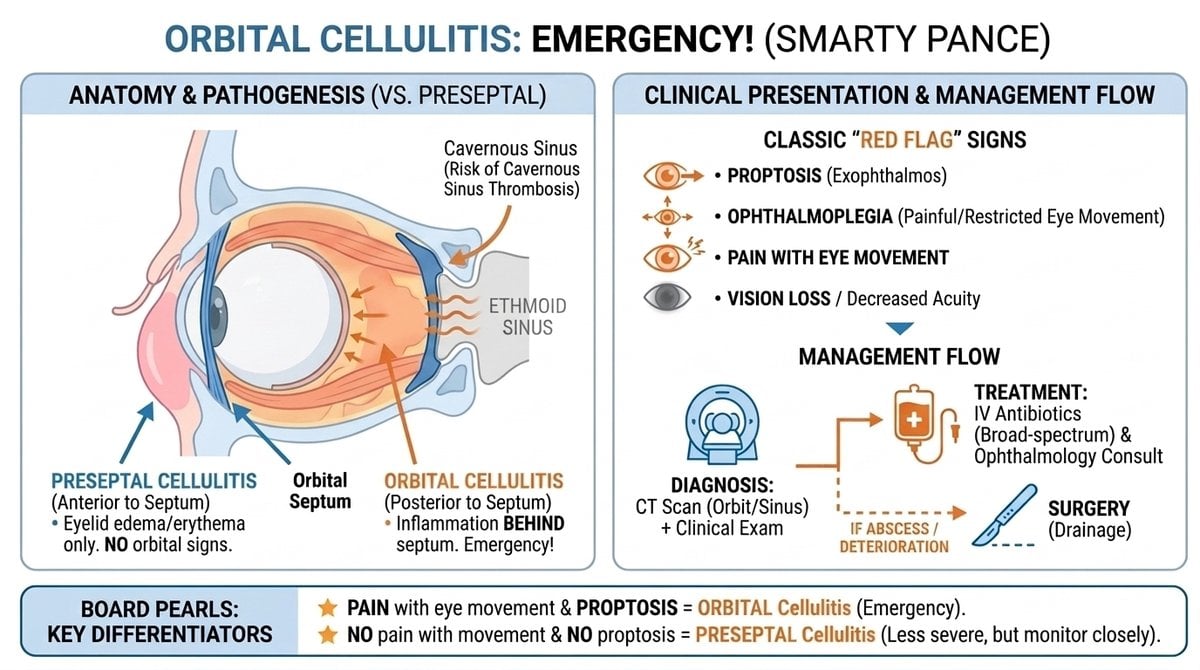
Orbital cellulitis is an infection of the orbital muscles and fat behind the eye (differentiate from periorbital cellulitis, which is only an infection of the skin)
- Patients will present with decreased extraocular movement (ophthalmoplegia), pain with movement of the eye, and proptosis (protrusion of the eye)
- May present with fever, decreased vision, and diplopia
- Often associated with untreated sinusitis. It occurs more often in children than adults - ages 7-12 y/o
- The most common pathogens are Staphylococcus aureus and streptococci (S. anginosus, S. pyogenes, S. pneumoniae). Nontypeable Haemophilus influenzae remains a cause when orbital cellulitis follows sinusitis, but H. influenzae type b (Hib) is now rare because of vaccination
- Decreased vision is a rare manifestation of orbital cellulitis
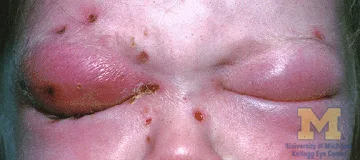
Involvement of muscles and fat behind the eye. Image: Jonathan Trobe, M.D., University of Michigan Kellogg Eye Center, CC BY 3.0, via Wikimedia Commons.
History, clinical exam, and focused assessment of extraocular muscles
- The imaging modality of choice for the diagnosis of orbital cellulitis is CT with contrast
- CBC and blood culture may be standard in some settings

CT showing odontogenic infection extending into the right maxillary sinus and orbit. Image: James Heilman, MD, CC BY-SA 3.0, via Wikimedia Commons.
If orbital cellulitis/abscess is seen on CT, it requires an ophthalmology evaluation
- Hospitalization and IV broad-spectrum antibiotics
- Vancomycin + ceftriaxone/cefotaxime is used in the empiric treatment of orbital cellulitis to cover methicillin-resistant Staphylococcus aureus (MRSA)
Question 1 |
erythema Hint: See D for explanation | |
fever Hint: See D for explanation | |
lid edema Hint: See D for explanation | |
worsening pain with eye movements | |
development of a rash on the face Hint: See D for explanation |
Question 2 |
H. influenzae type B Hint: Before widespread immunization, Haemophilus influenzae type B was the most common cause secondary to bacteremia (about 80% of cases) and remains so in nonimmunized populations. | |
Streptococcus pneumoniae | |
Moraxella catarrhalis Hint: See B for explanation | |
Staphylococcus aureus Hint: The most common pathogens associated with external foci (trauma) are Staphylococcus aureus and Streptococcus pyogenes, but these are seldom isolated from the blood | |
Pseudomonas aeruginosa Hint: See B for explanation |
Question 3 |
Oral amoxicillin-clavulanate and follow-up in 48 hours Hint: Oral antibiotics fit preseptal (periorbital) cellulitis, with no proptosis or painful eye movements. | |
Warm compresses and erythromycin eye ointment Hint: Compresses and ointment treat a stye or blepharitis, not a deep orbital infection. | |
Hospital admission and IV broad-spectrum antibiotics | |
Topical corticosteroid drops Hint: Steroid drops don't treat infection. | |
Observation, since it will clear with the sinus infection Hint: Untreated orbital cellulitis can cause vision loss and spread to the brain. |
|
List |
References: Merck Manual · UpToDate