

Patient will present as → a 27-year-old mezzo-soprano who states that she developed acute hoarseness 2 days ago. Prior to that, she had a cold, the symptoms of which are improving. There is no history of smoking or other tobacco use. She is very worried as she has an upcoming performance 3 days from now.
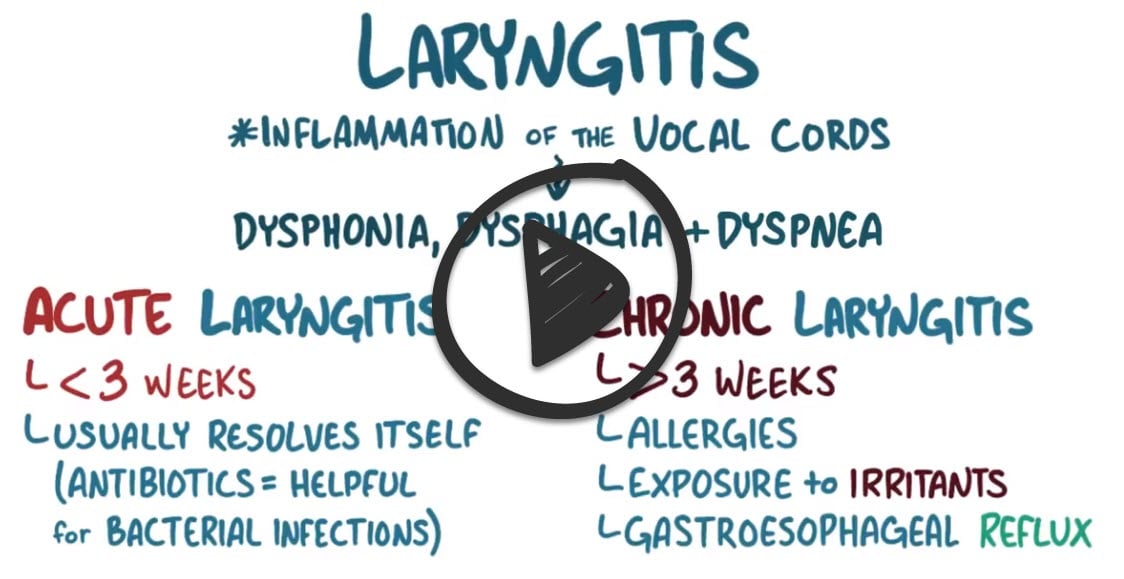
Laryngitis is inflammation of the larynx, usually the result of a virus or overuse. The result is an acute change in the voice, with decreased volume and hoarseness.
- Associated with a viral infection
- Consider squamous cell carcinoma if hoarseness persists > 2-3 weeks, history of ETOH and or smoking
- Consider GERD if no associated viral etiology
Diagnosis is based on clinical findings
- Laryngoscopy is required for symptoms persisting > 3 wk
- Deviation of the soft palate and asymmetric rise of the uvula are highly suggestive of abscess
Symptomatic treatment (eg, cough suppressants, voice rest, steam inhalations)
- Viral laryngitis is self-limited. Other infectious or irritating causes may require specific treatment.
- Oral or IM corticosteroids may also hasten recovery for performers but requires vocal fold evaluation before starting therapy.
Flashcards ready when you areYou have opened several Quizlet sets recently. Loading this one only when needed helps prevent a temporary Quizlet limit.
 Osmosis Osmosis |
|
 |
Question 1 |
A 56-year-old male with a 20-pack-year smoking history presents with a hoarse voice. He states his symptoms started 1 month ago and have not improved. He denies a history of fever, congestion, or previous upper respiratory infection (URI) symptoms. What condition must be considered?
GERD Hint: Although GERD should be in your differential, in this patients with a history of smoking and > 2 weeks of symptoms you must rule out Squamous cell carcinoma. | |
Squamous cell carcinoma | |
Acute viral laryngitis Hint: Although thi is always in the differential, the patient denies fever or URI symptoms. | |
Epiglottitis Hint: Epiglottitis presents commonly in children, is associated with respiratory distress, fever and drooling. You will see a thumbprint sign on lateral x-ray. | |
Gastroesophageal reflux disease (GERD) Hint: In a patient with a significant smoking history and persistent hoarseness lasting more than 2-3 weeks without other URI symptoms, laryngeal cancer must be considered. Smoking is a major risk factor for laryngeal cancer, and hoarseness can be an early sign due to tumor involvement of the vocal cords. This condition warrants prompt evaluation, including referral to an otolaryngologist for laryngoscopy to visualize the vocal cords and assess for malignancy. |
Question 1 Explanation:
Consider squamous cell carcinoma if hoarseness persists > 2 weeks and the patient has a history of ETOH and or smoking.
Question 2 |
A 45-year-old professional singer presents with a three-day history of hoarseness and difficulty projecting her voice. She recently completed a series of performances and reports some vocal strain. Additionally, she is experiencing a mild cough and sore throat. On examination, her temperature is normal, and there is no pharyngeal erythema or lymphadenopathy. Which of the following is the most appropriate initial management recommendation?
Amoxicillin Hint: Antibiotics are not indicated for laryngitis unless there is a clear bacterial etiology, which is unlikely given the patient's presentation. | |
Ibuprofen Hint: While ibuprofen may offer some symptom relief for discomfort and inflammation, vocal rest is considered the cornerstone of treatment in cases of laryngitis. | |
Prednisone Hint: Corticosteroids like prednisone may be considered in severe cases of laryngitis or when rapid recovery is important (such as for professional singers before a performance). However, given the typical self-limiting nature, routine use of prednisone is not recommended for a case like the one described. | |
Supportive care and vocal rest | |
Throat lozenges
Hint: Throat lozenges can offer some temporary relief of mild throat discomfort but do not directly address the underlying inflammation that causes the hoarseness. |
Question 2 Explanation:
In most cases, acute laryngitis is caused by viral infection or vocal strain and is self-limiting. The primary management approach focuses on supportive measures and vocal rest to allow the inflammation to subside.
There are 2 questions to complete.
|
List |
References: Merck Manual · UpToDate