

 Picmonic
3 y/o with unilateral ear pain
Patient will present as → a 3-year-old previously healthy male is brought to your office by his mother. The mother reports the child has been crying and pulling at his right ear over the past 2 days and reports the patient has been febrile the past 24 hours. The patient's past medical history is unremarkable, although the mother reports the patient had a "common cold" a week ago which resolved without intervention. His temperature is 101.6 F, blood pressure is 100/70 mmHg, pulse is 120/min, and respirations are 22/min. The otoscopic exam is seen here.
- Middle ear effusion (MEE) – Fluid in the middle ear cavity; MEE occurs in both AOM and otitis media with effusion (OME)
- Acute otitis media (AOM) – Acute bacterial infection of the middle ear fluid (also called suppurative otitis media)
- Otitis media with effusion (OME) – Middle ear fluid that is not infected; also called serous, secretory, or nonsuppurative otitis media. OME frequently precedes the development of AOM or follows its resolution. About 90% of children have OME at some time before school age, most often between ages 6 months and 4 years
- Chronic suppurative otitis media (CSOM) – when the infection persists in the middle ear space for more than 3 months and is associated with a chronic perforation of the tympanic membrane; presents as persistent otorrhea
AOM is usually precipitated by a viral URI, but the middle ear infection itself is bacterial in the great majority of cases (tympanocentesis studies detect bacteria in ~90%, often with viral co-infection). The bacterial causes mirror bacterial sinusitis, and the ranking has shifted since pneumococcal conjugate vaccines:
- Nontypeable Haemophilus influenzae – now the most common (34–60%); one-third to one-half of US strains produce beta-lactamase; associated with bilateral AOM and concurrent conjunctivitis ("otitis-conjunctivitis syndrome")
- Streptococcus pneumoniae – 15–25%; still the pathogen most associated with high fever, severe otalgia, and complications (mastoiditis, bacteremia)
- Moraxella catarrhalis – 12–15%; virtually all strains produce beta-lactamase
- Group A Streptococcus – 2–10%; older children, more TM perforation and mastoiditis
Acute vs. chronic vs. recurrent
- Acute: inflammation for less than 3 weeks
- Chronic: inflammation for greater than 3 months
- Recurrent: ≥ 3 episodes in 6 months or ≥ 4 episodes in 12 months (with at least one in the past 6 months) and clearing between episodes
Chronic OME (> 3 months)
- Clear serous fluid in the middle ear without signs or symptoms of acute infection
- May cause conductive hearing loss or be asymptomatic; does not require antibiotics
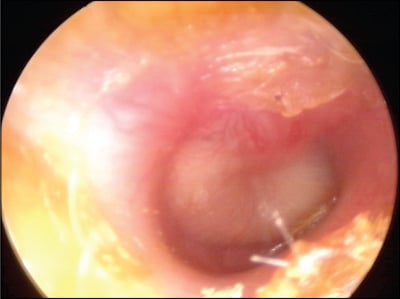
Clinical diagnosis by otoscopy — requires middle ear effusion + acute inflammation. Exam may reveal bulging, loss of landmarks, redness, injection of the TM, and pus
- Key findings are bulging of the TM and limited or absent mobility of the TM with pneumatic otoscopy — the most specific findings for AOM
- Erythema alone (from crying or fever) is not diagnostic — do not treat if the TM cannot be visualized or criteria are not met; re-examine if symptoms persist or worsen at 72 hours
- Bulging and eventual rupture of the TM can occur as well, leading to otorrhea and abruptly decreased pain

Acute otitis media - Note bulging, loss of landmarks, redness, injection of TM, and pus. Photo by Michael Hawke MD via Wikimedia Commons, CC BY 4.0.
Pain control for everyone — oral ibuprofen or acetaminophen whether or not antibiotics are started Children:
Antibiotic therapy vs. observation in children (AAP guideline)
| Age | Otorrhea | Severe symptoms (unilateral or bilateral) | Bilateral disease | Unilateral disease, no severe symptoms |
| < 6 months | Antibiotics | Antibiotics | Antibiotics | Antibiotics |
| 6 months to 2 years | Antibiotics | Antibiotics | Antibiotics | Antibiotics or observe 48 to 72 hours |
| ≥ 2 years | Antibiotics | Antibiotics | Antibiotics or observe 48 to 72 hours | Antibiotics or observe 48 to 72 hours |
Severe symptoms = toxic appearance, otalgia > 48 hours, or temperature ≥ 39°C (102.2°F). Observation requires reliable follow-up; start antibiotics if no improvement at 48–72 hours. Note: UpToDate now favors initial observation for most children who are not high-risk (high-risk = < 6 months, immunocompromised, toxic-appearing, craniofacial abnormalities) — the table above remains the board-tested standard.
First-line treatment for AOM in children
- Amoxicillin 90 mg/kg per day divided into two doses (maximum of 4 g/day) is the first-line drug of choice — high dose overcomes penicillin-nonsusceptible pneumococcus
- Augmentin 90 mg/kg per day of amoxicillin and 6.4 mg/kg per day of clavulanate divided into two doses (maximum 4 g/day of amoxicillin) is first-line for children who have received a beta-lactam antibiotic in the past 30 days, have recurrent AOM unresponsive to amoxicillin, or present with concurrent purulent conjunctivitis (beta-lactamase-producing NTHi)
AOM with perforation — amoxicillin 90 mg/kg per day orally divided in two doses (maximum 4 g/day) for 10 days; topical drops are not appropriate for a spontaneous perforation Treatment failure (no improvement at 48–72 hours)
- Failed amoxicillin → Augmentin
- Failed Augmentin or an oral cephalosporin → ceftriaxone 50 mg/kg IM once daily for 3 days (maximum 1 g/day); oral cephalosporins are not used after failure of high-dose amoxicillin
Children with a mild, non-IgE-mediated allergy to penicillin antibiotics (e.g., delayed rash)
- Cefdinir 14 mg/kg per day orally in one or two doses (maximum 600 mg/day)
- Cefpodoxime 10 mg/kg per day orally in two doses (maximum 400 mg/day)
- Cefuroxime tablets 250 mg orally every 12 hours (children > 17 kg who can swallow tablets; the suspension is no longer available in the US)
- Ceftriaxone 50 mg/kg intramuscularly once per day (maximum 1 g/day) for one to three doses
Azithromycin, clarithromycin, or clindamycin for the treatment of AOM in children who have had an immediate (IgE-mediated) hypersensitivity reaction or serious delayed reaction to amoxicillin or other beta-lactam antimicrobial agents
- Azithromycin 10 mg/kg per day orally (maximum 500 mg/day) as a single dose on day 1 and 5 mg/kg per day (maximum 250 mg/day) for days 2 through 5
- Clarithromycin 15 mg/kg per day orally divided into two doses (maximum 1 g/day)
- Clindamycin 30 mg/kg per day orally divided into three doses (maximum 1.8 g/day)
- ⚠️ These agents do not cover H. influenzae, and 25–35% of pneumococci are macrolide/clindamycin resistant — reserve for true allergy
- OME often occurs after acute otitis media (AOM), but it may also occur in young children without a preceding AOM due to eustachian tube dysfunction
- In general, OME is a spontaneously resolving condition, and watchful observation (for 3 months) is the preferred strategy — antibiotics, antihistamines, decongestants, and steroids are not indicated
- Refer for tympanostomy tubes if effusion persists > 3 months with hearing loss, or earlier in children with developmental delay, speech concerns, or specific conditions (such as cleft palate) in whom OME is often persistent
Recurrent AOM — ≥ 3 episodes in 6 months or ≥ 4 in 12 months with persistent effusion → refer to ENT for tympanostomy tubes
Adults:
Since AOM is unusual in adults, and complications may be significant, treat all adult patients with antibiotic therapy (no observation) First-line acute otitis media (AOM) treatment in adults In most adults, use Augmentin 875/125 mg orally twice daily x 5 - 7 days as first-line abx.
- In patients with more severe infection or at high risk for severe or resistant infection (age > 65, immunocompromised, antibiotics in the past month, ≥ 10% local penicillin-nonsusceptible S. pneumoniae) — use a high dose of the amoxicillin component: Augmentin 2000 mg/125 mg, extended-release, orally twice daily
If Augmentin is unavailable or cost-prohibitive (and no amoxicillin allergy), amoxicillin may be used as initial therapy:
- Amoxicillin 500 mg TID or 875 mg BID x 5-7 days
- In patients at high risk for severe infections or infections with resistant S. pneumoniae, amoxicillin 1000 mg orally three times daily
In PCN allergic patients without severe reactions and who do not have a known allergy to a cephalosporin:
- Cefdinir, 300 mg orally twice daily or 600 mg once daily
- Cefpodoxime, 200 mg orally twice daily
- Cefuroxime, 500 mg orally twice daily
- Doxycycline, 100 mg orally twice daily
- Ceftriaxone, 1 to 2 g intravenously (IV) or 1 g intramuscularly (IM) once daily for three days
For patients with a known severe allergy to beta-lactam antibiotics or who have a known allergy to cephalosporins, antibiotic choices include:
- Doxycycline, 100 mg orally BID x 5-7 days
- Levofloxacin 500–750 mg orally once daily or moxifloxacin 400 mg orally once daily (respiratory fluoroquinolones; FDA boxed warning)
- Azithromycin (500 mg orally on day 1, then 250 mg on days 2 through 5) or clarithromycin (500 mg orally BID x 5-7 days) only if doxycycline and fluoroquinolones are contraindicated — high pneumococcal macrolide resistance
Adult treatment failure at 48–72 hours → high-dose extended-release Augmentin (if not already used), ceftriaxone IV, or a respiratory fluoroquinolone; obtain middle ear fluid culture via ENT if second-line fails Chronic OME:
- Treat with myringotomy with ventilation tube insertion if fluid is persistent (> 3 months) and/or causing hearing loss
 Otitis media is an infection of the middle ear caused by a virus or bacteria and is characterized by the presence of fluid in the middle ear, along with symptoms of inflammation. This condition most commonly occurs in children due to the shorter, straighter, and narrower nature of the eustachian tube in childhood. Signs and symptoms of otitis media include a red, bulging tympanic membrane, ear pain, and fever. Children with an upper respiratory infection or those regularly exposed to smoke are at an increased risk of developing an ear infection. Conductive hearing loss may occur in chronic cases of otitis media. Antipyretics, analgesics, and antibiotics are typically used to treat otitis media; procedures such as a myringotomy or the placement of a tympanostomy tube may be necessary.
Question 1 |
improve hearing | |
prevent mastoiditis Hint: Mastoiditis is prevented by early treatment of otitis media with antibiotics. | |
prevent recurrence of effusion Hint: Effusion can occur even with tympanostomy tubes in place. | |
prevent delayed language development Hint: Tympanostomy tubes have not been proven to prevent delayed language development. |
Question 2 |
A 2-year-old boy is brought to your clinic by his mother due to fever, irritability, and pulling at his right ear for the past 24 hours. He has had minimal appetite and difficulty sleeping. His temperature is 38.5°C (101.3°F). On examination, the child is fussy but consolable. Otoscopic examination reveals a bulging, opaque, erythematous right tympanic membrane with poor mobility on pneumatic otoscopy. The left ear appears normal. Which of the following findings is most diagnostic of acute otitis media in this case?
bulging of the tympanic membrane | |
Erythema of the tympanic membrane Hint: Erythema of the tympanic membrane can be present in AOM but is nonspecific; it can also be caused by crying, fever, or a viral upper respiratory infection without middle ear infection. | |
Fever and irritability Hint: Fever and irritability are systemic symptoms commonly associated with AOM but are nonspecific and can occur with many other childhood illnesses. Diagnosis relies on otoscopic findings. | |
Opacification of the tympanic membrane Hint: Opacification of the tympanic membrane also indicates middle ear fluid but, like poor mobility, is not specific for an acute infection and can be seen in otitis media with effusion. | |
Poor mobility of the tympanic membrane Hint: Poor mobility of the tympanic membrane suggests middle ear effusion but does not distinguish between acute infection (AOM) and effusion without acute infection (otitis media with effusion). |
Question 3 |
Ciprofloxacin (Cipro) IV | |
Cefuroxime (Zinacef) IV Hint: Cefuroxime is a second-generation cephalosporin with no activity against Pseudomonas aeruginosa, the cause of more than 95% of necrotizing otitis externa. | |
Ampicillin-sulbactam (Unasyn) PO Hint: Ampicillin-sulbactam does not cover Pseudomonas, and oral therapy alone is inadequate for this invasive skull-base infection. | |
Azithromycin (Zithromax) PO Hint: Azithromycin has no activity against Pseudomonas aeruginosa. | |
Amoxicillin-clavulanate (Augmentin) PO Hint: Amoxicillin-clavulanate does not cover Pseudomonas aeruginosa and is not adequate for necrotizing otitis externa. |
Question 4 |
Staphylococcus aureus Hint: Staphylococcus aureus is an uncommon cause of acute otitis media; it is more typical of otitis externa and chronic suppurative otitis media. | |
Moraxella catarrhalis Hint: Moraxella catarrhalis is one of the three major pathogens of acute otitis media, but it is less common than Streptococcus pneumoniae and nontypeable Haemophilus influenzae. | |
Pseudomonas aeruginosa Hint: Pseudomonas aeruginosa is the classic cause of otitis externa (swimmer's ear) and necrotizing (malignant) otitis externa, not acute otitis media. | |
Streptococcus pneumoniae | |
Streptococcus pyogenes Hint: Group A streptococcus causes only a small minority of acute otitis media cases and is more often associated with pharyngitis. |
Staphylococcus aureus and Pseudomonas aeruginosa are uncommon causes of acute otitis media; Pseudomonas is the classic cause of otitis externa. Group A streptococcus accounts for only a small share of cases.
Question 5 |
Mycoplasma pneumoniae Hint: Mycoplasma pneumoniae is a common cause of bronchitis and pneumonia. | |
Pneumocystis jiroveci Hint: Pneumocystis jiroveci is associated with immunocompromised respiratory illness. | |
Pseudomonas aeruginosa Hint: Pseudomonas aeruginosa would most commonly cause otitis externa. | |
Streptococcus pneumoniae |
|
List |
References: Merck Manual · UpToDate (children) (adults)